
Table of Contents
- Durable Gear That Holds Up Under Pressure vs Gear Designed to Endure Rigorous Training
- What Makes Durable Workout Clothes Actually Last
- The Best Fabric for Workout Clothes That Take a Beating
- Stay Put Workout Clothes: Fit Retention Through Squats, Pulls, and Sprints
- How to Choose Durable Activewear: A Cost-Per-Wear Framework
- Pilling, Abrasion, and Shape Retention After Repeated Washing
- Moisture Management and Breathability in Heavy Lifting and Conditioning
- Frequently Asked Questions
Last Updated: October 15, 2026
Durable Gear That Holds Up Under Pressure vs Gear Designed to Endure Rigorous Training
Most workout clothes fail quietly: a seam loosens, a waistband rolls, fabric pills at the thigh, and your "performance" gear becomes a yard-work rag.
At Mayhem Performance Apparel, we build for the second category: gear engineered for athletes who train under load. Here is what separates durable activewear from disposable gear, using five pieces from our lineup as reference points.
The Comparison Table: Five Pieces Built for Repeated Stress
| Piece | Fabric & Weight | Price | Key Durability Feature | Best For |
|---|---|---|---|---|
| Midweight Fleece Joggers | 8.25 oz cotton blend, 3-end fleece | $59.99 | Tightly knit fleece resists everyday wear | Recovery days, warmups, everyday training |
| Heavyweight Oversized T | 7.5 oz 100% cotton | $59.99 | Double-needle stitched collar | Heavy lifting, layering, repeated washing |
| Midweight Performance Hoodie | 8 oz Airlume combed cotton fleece | $99.99 | Side-seam construction for shape retention | Warmups, recovery, outside the gym |
| Moisture Wick Track Pants | 7.8 oz poly/spandex blend | $74.99 | Four-way stretch, zippered pockets | Conditioning, sprint work, layering |
| Moisture Wick Shorts | 3.5 oz poly/spandex blend | $49.99 | Moisture-wicking, 7-inch inseam | Heavy lifting, conditioning, hot sessions |
Every piece is specified by fabric weight and construction detail, not a vague promise. That is how you should evaluate durable workout clothes from any brand.

What Makes Durable Workout Clothes Actually Last
Durability comes down to three measurable things: fabric weight, seam construction, and how the garment handles repeated washing. Heavier fabric resists thinning, reinforced seams resist blowouts, and tightly knit construction resists pilling and abrasion.
Fabric weight is measured in ounces per square yard. A 7.5 oz cotton tee is roughly twice the substance of a standard 4 oz shirt, which is why heavyweight garments hold their shape through dozens of wash cycles while thin shirts go limp after five.
Seam Strength, Fabric Weight, and Reinforced Construction
Seam failure is the number one reason training apparel gets retired early: a single-needle stitch at a stress point like a collar or crotch seam pulls apart long before the fabric wears out. Our Heavyweight Oversized T uses a reinforced double-needle stitched collar, and our Midweight Performance Hoodie uses side-seam construction to hold its shape through repeated wear and washing.

The Best Fabric for Workout Clothes That Take a Beating
The best fabric for workout clothes that take a beating depends on the job. For strength training and everyday wear, heavyweight cotton and cotton blends win on durability.
Here is the honest breakdown:
- Heavyweight cotton (7.5 oz and up): Maximum abrasion resistance, holds shape, breathes well. Best for lifting and layering.
- Cotton blends with fleece backing: Warmth plus structure. Best for joggers and hoodies.
- Poly/spandex blends: Four-way stretch, moisture-wicking, quick-drying. Best for shorts, track pants, and anything where sweat volume is high.
A common mistake is buying one fabric type for everything. You would not wear a heavyweight cotton hoodie through a July conditioning circuit, nor lightweight spandex shorts to a cold-weather squat session.

Textile durability and abrasion testing standards from ASTM International cover how fabric resistance is measured in laboratory conditions.
Stay Put Workout Clothes: Fit Retention Through Squats, Pulls, and Sprints
Stay put workout clothes are engineered so the waistband, cuffs, and hems stay where you put them through full-range movement.
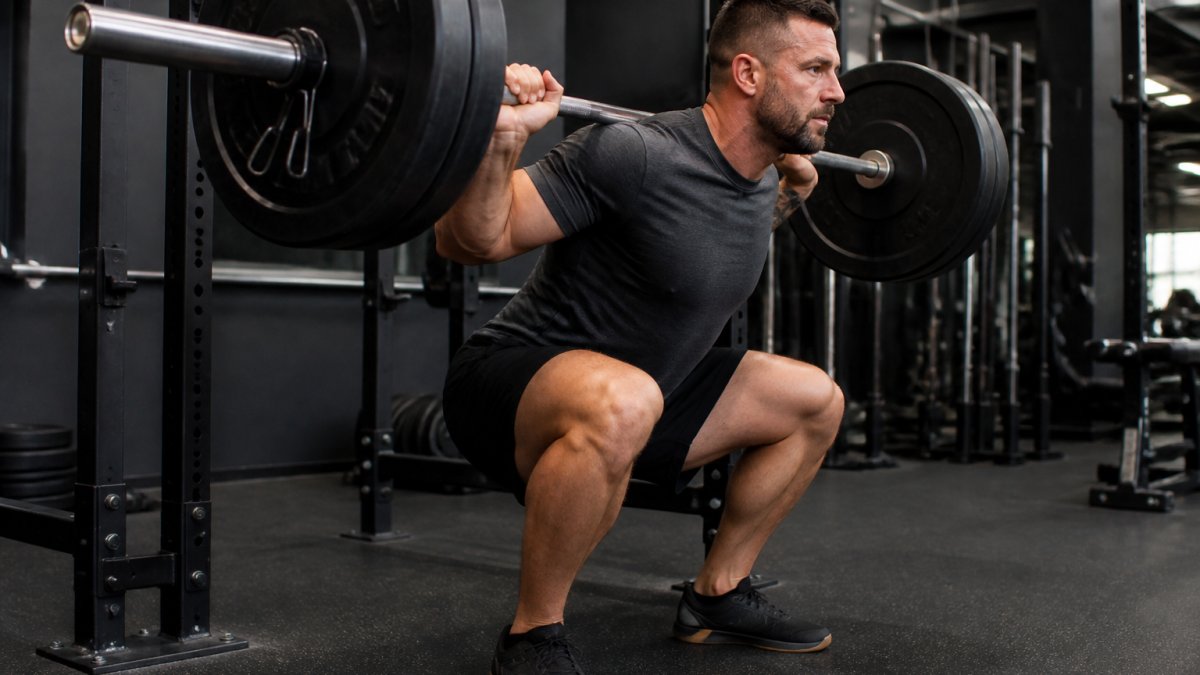
Most guides stop at "look for a drawcord," which is not enough to predict whether a garment will stay put. The three failure modes that send training apparel to the back of the drawer are waistband roll, leg ride-up, and torso shift, each needs its own check.
Waistband Roll: Test It Under a Loaded Squat
Waistband roll happens when the elastic band folds over itself under compression, most commonly in a deep squat or heavy deadlift setup where the hips flex past 90 degrees.
A practical test: put the garment on, stand tall, and press two fingers under the front of the waistband.
Our Moisture Wick Shorts pair an internal drawcord with four-way stretch fabric, so the garment moves with your hips without sliding down, keeping the band flat at the bottom of a squat instead of folding over.
Leg Ride-Up: Test It During Sprints and Sled Work
Leg ride-up is the creeping migration of a short's hem toward the hip during repeated hip extension, sprints, sled pushes, step-ups, and high-rep kettlebell swings.
A practical test: do 20 bodyweight squats, 20 high knees, then a 30-second wall sit.
Our Midweight Fleece Joggers use an elastic waistband with an adjustable drawstring and ribbed tapered cuffs, so the ankle stays put through sprints and sled pushes.
Torso Shift: Test It During Floor Work and Pulls
Torso shift is the sideways or upward migration of a top during floor work, pull-ups, and overhead pressing.
A practical test: do 10 burpees, 10 pull-ups, and a 30-second plank, then check whether the hem is still at your hip line and the shoulders have crept toward your ears.
Our Midweight Performance Hoodie uses side-seam construction for exactly this reason, the side seam gives the garment a structural line to hold, so it does not twist or ride up.
Why This Matters More Than Fabric Spec Alone
A garment can have perfect fabric weight and still fail the stay-put test. Fabric weight tells you how long a piece will last; fit retention tells you whether you will actually wear it. When comparing durable gear against gear designed for rigorous training, ask which failure mode the brand addressed, waistband roll, leg ride-up, or torso shift, because that answer tells you more than any durability claim on the label.
How to Choose Durable Activewear: A Cost-Per-Wear Framework
Cost per wear is the only pricing metric that matters for training apparel. A $50 pair of shorts worn twice a week for two years costs about $0.24 per wear; a $25 pair that falls apart in four months costs about $0.78 per wear. The cheaper garment is three times more expensive in practice. But cost per wear only works if you can estimate lifespan honestly, which requires an objective durability standard and a clear picture of how durable gear and gear designed for rigorous training differ.
The Objective Durability Standards You Can Actually Check
Durability claims are usually vague; the underlying tests are not. Knowing what published standards measure lets you ask better questions even when a brand does not publish results.
- Abrasion resistance. The Martindale method rubs fabric against a standard abrasive under a set load and counts cycles until wear shows; the Taber method does the same with a rotating wheel.
- Seam strength. Seam slippage and strength tests pull a stitched seam apart under controlled force and record the load at failure. A reinforced double-needle seam typically withstands more force than a single-needle seam at the same stress point.
- Stretch recovery. Elastic recovery tests stretch a fabric to a set extension, hold, release, and measure the return to original length. Poor recovery is what leaves a waistband stretched out after a squat.
Textile durability and abrasion testing standards from ASTM International cover how fabric resistance is measured in laboratory conditions. Consumer apparel rarely publishes those results, which is why construction detail is your best practical proxy.
Durable Gear vs Gear Designed for Rigorous Training: The Real Trade-Off
These two descriptions are not synonyms, and treating them as one is where most buyers go wrong.
Durable gear prioritizes survival: heavier fabric, reinforced seams, and construction that resists abrasion and shape loss.
Gear designed for rigorous training prioritizes movement: lighter, stretchier fabrics with moisture management and four-way stretch.
The best training kit uses both, assigned to the right job.
- Strength work and layering: durable gear wins. Heavier fabric holds shape under load and resists abrasion from bars, belts, and benches.
- Conditioning and hot sessions: rigorous-training gear wins. Lighter stretch fabric manages sweat and moves with repeated hip extension.
- Everyday training: the middle ground. A midweight blend with reinforced seams and moderate stretch covers most sessions without overcommitting to either extreme.
A Cost-Per-Wear Framework With Real Lifespan Assumptions
Here is how to run the math before buying anything:
- Estimate wears per year. Two sessions a week equals roughly 100 wears a year; four equals roughly 200.
- Estimate realistic lifespan by construction type. Heavyweight fabric with reinforced seams typically outlasts lightweight construction by two to three times the usable wear cycles at the same training frequency.
- Divide price by total wears. This is your true cost.
- Add replacement friction. Time spent reordering, re-fitting, and breaking in new gear is a real cost.
Run this against our lineup: the Moisture Wick Shorts at $49.99, worn twice a week for two years, land near a quarter per wear. The Heavyweight Oversized T at $59.99, worn twice a week for three years, lands near $0.19 per wear. That is the case for buying durable gear once instead of disposable gear repeatedly.
Where to Spend and Where to Save
Not every piece needs to be the most durable option. Spend on the pieces that take the most abuse: shorts and tees that rub against equipment, and anything worn against the skin during high-sweat sessions. Save on layering pieces that spend most of their life on a hook.
Pilling, Abrasion, and Shape Retention After Repeated Washing
Pilling and abrasion are the visible signs of fabric degradation.
Tightly knit fabric resists both. Our Midweight Fleece Joggers use a tightly knit 3-end fleece construction to resist everyday wear and hold structure through repeated workouts.
Shape retention after washing depends on fiber quality and how you wash. Cold water and low heat preserve elasticity and prevent shrinkage; hot water and high heat accelerate fiber breakdown in every fabric type.
Moisture Management and Breathability in Heavy Lifting and Conditioning
Moisture management separates gear that works in a hot gym from gear that turns into a wet towel.
Our Moisture Wick Track Pants and Moisture Wick Shorts both use poly/spandex performance blends.
Breathability matters just as much for cotton pieces.
American Council on Exercise guidance on training apparel and heat covers why fabric choice affects performance during high-sweat sessions.
Federal Trade Commission guidance on textile labeling and fiber content claims explains the labeling rules that govern what brands can claim about fiber content, which is useful when you are comparing fabric specs across products.
Training does not care whether your gear was built to last.
Frequently Asked Questions
What makes gym clothes durable enough for rigorous training?
Three things matter most: fabric weight, seam construction, and fiber blend. Heavier fabrics like 8.25 oz fleece or 7.5 oz cotton resist breakdown longer than thin knits. Reinforced double-needle stitching at stress points stops seams from splitting. Blends that mix cotton with polyester or spandex hold shape better than 100% cotton. A durable piece should survive repeated washing without pilling, stretching out, or losing its structure.
How can you tell if stay put workout clothes will actually stay in place?
Look for an internal drawcord or elastic waistband that adjusts to your body, not just a fixed band. Ribbed cuffs and tapered hems grip without cutting off circulation. Four-way stretch fabric moves with you instead of shifting against you. For lifting, fit matters more than compression level. Gear that stays put through a full squat session usually has both a secure waistband and fabric that returns to shape after stretching.
What fabrics hold up best to frequent workouts and washing?
Poly/spandex blends resist pilling and hold shape through dozens of wash cycles. Heavyweight cotton blends (like 80% cotton with 10% polyester) balance softness with structure. Airlume combed cotton sponge fleece resists pilling better than standard fleece. Avoid thin 100% cotton knits for training. They lose shape fast. Moisture-wicking synthetics dry quicker and handle sweat without getting heavy or smelly.
How often should you replace workout clothes used for heavy training?
It depends on cost per wear, not calendar time. Gear that costs $59.99 and lasts two years of daily training costs about $0.08 per session. Cheap gear that falls apart in three months costs more per wear. Replace items when seams split, fabric pills heavily, waistbands lose elasticity, or the fit no longer stays put during movement. Track how many washes each piece survives before it degrades.
Are compression clothes useful for training durability?
Compression apparel can support muscles and reduce movement during lifts, but compression alone does not equal durability. A compression piece made from thin fabric will still pill, tear, or lose elasticity. What matters is the fabric weight, seam strength, and stretch recovery. Graduated pressure helps with circulation during recovery, but for heavy lifting, prioritize fit retention and abrasion resistance over compression level.
0 comments