
Table of Contents
- Why Powerlifters Are Looking for a Gorilla Wear Alternative
- Powerlifting Apparel Requirements: What the Gear Must Do
- Fabric and Construction: Durability That Survives Heavy Lifting
- IPF-Approved Gear: Competition Standards That Matter
- Best Powerlifting Clothing Brands: Comparing the Top Options
- Durable Gym Wear for Heavy Lifting: Mayhem Performance Apparel Lineup
- Sizing and Fit for Different Body Types
- Final Verdict: Making the Switch
- Frequently Asked Questions
Last Updated: September 9, 2026
Why Powerlifters Are Looking for a Gorilla Wear Alternative
The search for a Gorilla Wear alternative for powerlifters usually starts the same way: a lever belt or pair of knee sleeves finally gives out, or a favorite training tee loses its shape after a few hard cycles. At Mayhem Performance Apparel, we build apparel for athletes who train under load daily, evaluating every piece on the same criteria a powerlifter uses: will it survive the next twelve months of squats, presses, and deadlifts without breaking down?
Many powerlifters also want an alternative because they have outgrown the general fitness aesthetic. A Gorilla Wear alternative for powerlifters should prioritize tensile strength, seam reinforcement, and fabric weight over flashy branding, performing during a 5-rep max attempt, not just looking aggressive in a mirror.
Powerlifting Apparel Requirements: What the Gear Must Do
Powerlifting apparel requirements go beyond basic comfort. The clothing must allow a full range of motion through the bottom of a squat, resist abrasion from the barbell and bench, and manage sweat during long sessions. Fabrics that bind, roll, or lose elasticity mid-workout are disqualifying.
The core requirements break down into three performance zones:
- Upper body: Shirts must withstand bar contact during squats and bench presses without tearing or pilling.
- Lower body: Shorts and pants need four-way stretch for hip drive and deep knee flexion.
- Thermal regulation: Moisture-wicking fabric keeps you dry between attempts, which matters when sessions run two hours or more.
Compression gear, wrist wraps, and knee sleeves handle joint stability, but your base layer carries the load of daily training stress. USA Powerlifting equipment standards clarify what is allowed on the platform, yet your everyday training apparel faces a tougher test: repeated washing, chalk dust, and barbell knurling.
Fabric and Construction: Durability That Survives Heavy Lifting
The single biggest mistake lifters make is buying gym apparel based on fabric weight alone. A heavy cotton shirt can feel durable in hand and still fail at the seams under tension. What matters is the combination of fabric density, stitch construction, and how the garment holds its shape after dozens of washes, and how the fabric's mechanical properties affect your performance under the bar.
Most general athletic wear uses low-tension knits that stretch easily in all directions, fine for a jog, but a liability in a heavy squat. When you descend into the bottom position, a loose, low-tension fabric allows your torso to shift and your shoulders to roll forward, subtly altering your bar path. A fabric with higher tensile stiffness in the vertical plane resists that deformation, helping you hold your brace and keep your upper back set.
This is where directional stretch becomes critical. A powerlifting-specific training shirt should offer high stretch horizontally (across the chest and shoulders) for unrack and arm positioning, but higher resistance vertically (from shoulder to hem) to prevent the fabric from riding up or losing contact with your lats during the descent. Standard gym shirts, with equal stretch in both directions, stretch out at the shoulders after a few months of bar contact, and the collar loses its structure, which can distract you during a 1-rep max attempt.
Compression levels also play a role. Light compression can improve proprioception, helping you stay tight through the bottom of a squat. Moderate compression can support your brace, but excessive compression restricts diaphragmatic breathing. The right approach is a shirt that fits snugly across the shoulders and chest but does not compress the abdomen, with a cut tapered at the waist but not compressive, allowing a full brace.
Construction details separate performance gear from fashion pieces. Reinforced double-needle stitching at stress points prevents blowouts during explosive movements. Flatlock seams reduce chafing, and a tagless design eliminates mid-set irritation. But the most overlooked detail is the hem: a straight hem with a heavy, non-rolling band stays put when you set up for a deadlift, while a curved hem tends to ride up and bunch.
Fabric choice depends on your training environment. Heavyweight 100% cotton, around 7.5 oz, suits lifters who want structure and durability in a cool gym, with a dense weave that resists barbell abrasion. Performance blends with poly-spandex offer moisture management and stretch for hot, high-volume training, but the spandex content must be balanced, too much and the garment loses structure; too little and it does not recover between reps. Tri-blend fabrics rarely excel at either extreme, making them a poor choice for dedicated powerlifting work.
A practical test for fabric tension: put the shirt on and perform an unrack position with an empty barbell. If the fabric wrinkles excessively across your upper back or pulls up at the hem, it lacks the vertical stiffness needed for a stable squat setup. If it binds across the chest when you bring your hands in for a bench press, the horizontal stretch is insufficient. The ideal training shirt moves with you, does not restrict your brace, and holds its shape rep after rep.
IPF-Approved Gear: Competition Standards That Matter
IPF-approved gear requirements matter if you compete in raw or equipped powerlifting. The International Powerlifting Federation has strict rules about what you can wear on the platform, covering everything from singlet specifications to the thickness of supportive equipment (powerlifting.sport). International Powerlifting Federation technical rules govern approved attire during competition.
Understanding the distinction between training gear and competition gear prevents costly mistakes. Your everyday Gorilla Wear alternative for powerlifters does not need IPF approval for training sessions. But if you plan to compete, you need a singlet that meets federation specifications and lifting shoes with a rigid, non-compressible sole.
Competition rules also restrict supportive equipment like knee wraps and bench shirts by thickness and construction. A lever belt, for instance, must meet specific width and thickness limits. Before you invest in competition-specific gear, verify the current rules for your federation and weight class.
Best Powerlifting Clothing Brands: Comparing the Top Options
When evaluating the best powerlifting clothing brands, the market splits into two camps: general athletic brands that happen to sell to lifters, and performance-focused companies that engineer for the sport. The difference shows up in fabric specifications and construction details.
Brand Type |
Fabric Approach |
Construction Focus |
Best For |
|---|---|---|---|
General athletic |
Lightweight blends |
Fashion-forward fits |
Casual training |
Performance-focused |
Heavyweight, dense weaves |
Seam reinforcement |
Heavy, frequent lifting |
Hybrid |
Mid-weight technical |
Balanced durability |
Cross-training athletes |
Performance-focused brands specify exact fabric weights, like 7.5 oz cotton or 7.8 oz poly-spandex blends, rather than vague "premium" claims. They reinforce stress points and design athletic fits that accommodate muscular builds without binding across the shoulders or hips.
Durable Gym Wear for Heavy Lifting: Mayhem Performance Apparel Lineup
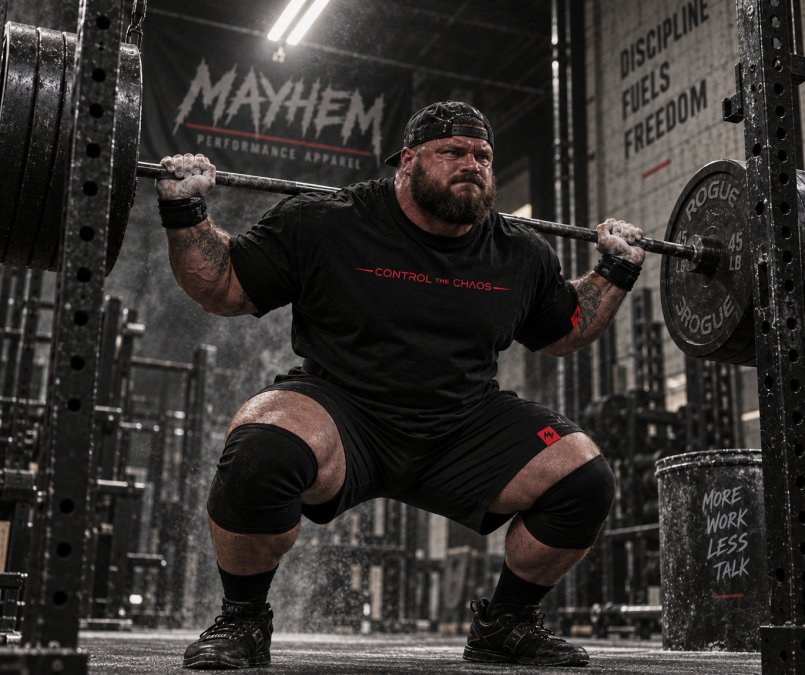
Mayhem Performance Apparel builds durable gym wear for heavy lifting with specific fabric weights and construction methods designed for athletes who train regardless of circumstance. The lineup covers the full training cycle, from heavy working sets to warm-ups and recovery.
Heavyweight Oversized T and Classic Performance T
The Heavyweight Oversized T ($59.99) uses 7.5 oz 100% cotton with a reinforced double-needle stitched collar. The oversized athletic fit provides unrestricted movement through the bottom of a squat, while the heavy fabric resists barbell abrasion. A tagless design eliminates irritation during long sessions.
The Classic Performance T ($49.99) takes the opposite approach with lightweight, breathable technical fabric. It manages moisture during high-volume training.
Moisture Wick Shorts and Track Pants
The Moisture Wick Shorts ($49.99) use a lightweight 3.5 oz poly-spandex blend with four-way stretch. The fabric breathes during heavy sets while the stretch allows full hip drive, staying in place through a full session without riding up or binding.
The Moisture Wick Track Pants ($74.99) step up to a 7.8 oz poly-spandex blend for cooler training days. Secure zippered pockets protect your essentials, and ankle zippers let you pull them on and off over lifting shoes without breaking your setup routine.

Midweight Performance Hoodie
The Midweight Performance Hoodie ($99.99) serves the warm-up and recovery phases of training. Crafted from 8 oz Airlume combed cotton sponge fleece, it provides warmth without restricting mobility. Ribbed cuffs and a waistband maintain a secure fit, while side-seam construction resists warping through repeated wear.
Sizing and Fit for Different Body Types
Powerlifters come in every shape, and athletic-fit apparel must accommodate genuine variety. A 220-pound lifter with a 32-inch waist has different needs than a 165-pound lifter with broad shoulders. Years of heavy squatting and pulling build muscle in specific places, thick quads, developed glutes, a broad back, and powerful shoulders, that general athletic wear simply does not accommodate.
The Squat-Built Lifter (Thick Quads and Glutes): If you have a 32-inch waist but 26-inch thighs, most standard shorts will bind at the leg opening or ride up during the descent. Look for shorts with a gusseted crotch and a wider leg opening. A 7-inch inseam is a good starting point, but the critical measurement is the leg opening circumference, at least 2 inches larger than your thigh measurement at the widest point to avoid compression that restricts blood flow or causes the fabric to roll. For pants, a tapered fit is your enemy; you need a straight or slightly relaxed leg that allows full knee flexion without pulling the waistband down.
The Broad-Back Lifter (Developed Lats and Shoulders): A 40-inch chest with a 34-inch waist is common among powerlifters who bench and row heavy. Standard shirts cut for a V-taper will be tight across the lats and loose at the waist. The solution is a shirt with a "muscle fit" or "athletic fit" that provides extra room in the shoulders and upper back without turning into a tent at the waist. Look for a drop shoulder or raglan sleeve construction, which allows greater arm movement without pulling the collar. The collar itself must be reinforced, a wide neck opening will stretch out and slip off your traps during a squat.
The Short-Limbed Lifter (Long Torso, Short Arms and Legs): This body type struggles with sleeve and inseam lengths. A standard long-sleeve shirt will have cuffs that bunch at the wrist, interfering with wrist wraps. Look for shirts with a shorter sleeve length or a raglan sleeve that does not extend past the mid-forearm. For pants, a 30-inch inseam is often too long, causing fabric to bunch at the ankle and interfere with your deadlift setup. A 28-inch inseam or a pant with a tapered ankle (but not a tapered thigh) is a better fit.
The Heavier Lifter (240 lbs and above): At this size, standard XXL sizes often assume a larger waist but not necessarily a larger chest and shoulder width. The result is a shirt that fits the waist but binds across the back. Look for brands that offer a "big and tall" athletic fit, which adds room in the chest and shoulders without adding excessive length. For shorts, a higher-rise waistband (10-11 inches) prevents the waistband from rolling down during heavy squats, a common complaint among bigger lifters.
A common pattern is that lifters buy one size up to accommodate their back or thighs, only to find the garment is too loose elsewhere. The fix is not a larger size but a different cut, a tailored athletic fit, roomier in the shoulders and chest and tapered at the waist, outperforms a standard large or XL. Similarly, shorts with a drawstring waistband and gusseted crotch offer more adjustability than a fixed elastic waistband. When you find a brand that fits your proportions, stick with it.
Final Verdict: Making the Switch
Switching from a Gorilla Wear alternative for powerlifters to Mayhem Performance Apparel comes down to one question: does the gear hold up under your training? General fitness brands design for moderate use. Performance apparel engineered for athletes who operate under load uses heavier fabrics, reinforced stitching, and athletic fits that survive daily training.
The Mayhem Performance Apparel lineup covers the full training cycle: the Heavyweight Oversized T handles heavy squats and bench sessions, the Classic Performance T manages high-volume conditioning, moisture-wick shorts and track pants provide unrestricted lower-body movement, and the Midweight Performance Hoodie covers warm-ups and recovery.

Finding a Gorilla Wear alternative for powerlifters means demanding more from your apparel than a logo. You need fabric that survives barbell contact, construction that holds through hundreds of washes, and fits that accommodate a strength athlete's build. Mayhem Performance Apparel builds premium gym and fitness clothing for athletes who refuse to negotiate with standards, engineered to withstand relentless stress and heavy-duty use. Shop the full lineup and gear up for training that endures as long as you do.
Frequently Asked Questions
What should powerlifters look for in gym apparel?
Powerlifters need gear that handles friction from the bar and bench without tearing. Look for heavyweight cotton around 7.5 oz or poly-spandex blends with four-way stretch. Seams should be reinforced with double stitching, especially around the collar and shoulders. Moisture-wicking fabric keeps you dry between heavy sets. Fit matters too: shirts should allow full range of motion for squat setup, and shorts or pants must stay in place through deep squats without rolling down or binding.
Is Gorilla Wear a reputable brand for powerlifting?
Gorilla Wear has a long history in bodybuilding and strength sports, and their products generally hold up well. However, powerlifters often find their sizing inconsistent across different product lines, and some items prioritize a bodybuilding aesthetic over the specific needs of squat, bench, and deadlift training. A Gorilla Wear alternative like Mayhem Performance Apparel focuses on the specific demands of heavy lifting, with heavier fabrics and construction details that matter for competitive lifters.
What are the IPF-approved gear requirements for powerlifting?
The IPF has strict rules for competition gear. For apparel, singlets must be one-piece, made from one layer of non-compression fabric, and have no logos beyond sponsor placement rules. T-shirts worn under the singlet must be plain, cotton or cotton-blend, and cannot have a collar or compression fit. Your focus should be on training gear that mimics competition conditions, but you will still need a dedicated IPF-legal singlet for meet day.
What fabric blends are best for heavy-duty powerlifting training?
For upper body, a heavyweight 100% cotton shirt around 7.5 oz provides a durable bar path and resists snags from knurling. For bottoms, a poly-spandex blend offers the stretch and moisture-wicking properties needed for squat depth and repeated washing. Avoid tri-blend fabrics for heavy lifting days, as they prioritize softness over tensile strength. Look for a 3.5 oz to 7.8 oz poly-spandex range, which balances breathability with enough structure to hold up under load.
Do powerlifters need specialized clothing for squatting and deadlifting?
Yes, but not in the way most people think. You do not need a separate shirt for squats versus deadlifts. You need gear that allows unrestricted range of motion. Shorts or pants must have enough stretch to let you hit proper depth without the waistband rolling down. Shirts should have reinforced seams that survive the bar's friction during heavy pulls. This is where durable gym wear for heavy lifting differs from general athletic wear.
0 comments