
Table of Contents
- Powerlifting Competition Gear Requirements
- How to Choose Lifting Shoes for Squat, Bench, and Deadlift
- Best Athletic Gear for CrossFit and Hybrid Training
- Fabrics That Survive Heavy Lifting: Moisture-Wicking and Abrasion Resistance
- How to Choose Powerlifting Apparel for Your Body Type
- Training Apparel vs. Competition Gear: What Changes on Meet Day
- Conclusion
- Frequently Asked Questions
Last Updated: September 11, 2026
Powerlifting Competition Gear Requirements
Learning how to choose powerlifting apparel starts with one hard truth: your training clothes will not get you on the platform. Meet-day rules will keep you off it. Powerlifting apparel for competition is regulated equipment, and the rules come from the federation running your meet, not from the brand selling you a singlet.
The USA Powerlifting rulebook and similar federation rulebooks define what is legal on the platform. Read the version your meet uses, because specifics shift between organizations and seasons.
Singlet Rules and Federation Standards
A singlet is a one-piece lifting garment worn over the torso and thighs during competition, required in every major federation for the squat, bench press, and deadlift (usapowerlifting.com). It must be a single layer, non-supportive, and fitted enough that judges can see the depth of your squat and the lockout of your knees.
What most lifters miss: the singlet is measured against your body, not your ego. A loose singlet bunches at the hip crease and can obscure squat depth from a side judge. A singlet that is too tight restricts the shoulder rotation you need to set your bench arch. Buy for the lift, not the look.
Federation checks that actually get enforced:
- Single-layer construction, no reinforced panels
- No additional support through the hips or thighs
- Logos within the size limit set by your federation
- Clean, undamaged fabric at weigh-in
Approved Accessories: Belts, Sleeves, and Wraps
Accessories are where rule compliance gets complicated. A weightlifting belt is legal in raw divisions within thickness and width limits. Knee sleeves are permitted for warmth and joint support, but they must be non-supportive neoprene, not a rigid knee wrap (usapowerlifting.com). Wrist wraps are allowed within length limits and cannot extend past the hand.
The distinction that decides legality: sleeves support, wraps assist. Most raw federations allow neoprene sleeves and disallow stiff wraps that store elastic energy. If you are unsure which category your gear falls into, ask your meet director before the day, not on it.
How to Choose Lifting Shoes for Squat, Bench, and Deadlift
Lifting shoes are the single piece of powerlifting apparel that changes your mechanics, not just your comfort. The right shoe depends on which lift you are prioritizing and how your body moves under a barbell.
Heel elevation raises your heel relative to your toe, which increases ankle dorsiflexion and lets you hit squat depth with a more upright torso. Lifters with long femurs or limited ankle mobility usually squat better in a raised heel. Flat sole shoes put your foot level with the floor, which maximizes ground contact and stability for the deadlift and the bench press.
Heel Elevation vs. Flat Sole: Which Works for Your Lift
Shoe Type |
Best For |
Why It Works |
Trade-Off |
|---|---|---|---|
Raised heel |
Squat |
More ankle range, upright torso |
Less stable for pulls |
Flat sole |
Deadlift, bench |
Maximum ground contact |
Limits squat depth |
Hybrid trainer |
General training |
One shoe for everything |
Compromises both |
Many competitive lifters carry two pairs: a raised-heel shoe for squat and a flat shoe for deadlift and bench. If you only buy one pair, match it to your weakest lift. The shoe that fixes your squat will not fix your pull.
Best Athletic Gear for CrossFit and Hybrid Training
Hybrid athletes need apparel that survives two different demands in the same session: the barbell and the conditioning. That means one garment has to resist abrasion from a knurled bar and still breathe through a metcon.
Moisture-wicking fabric moves sweat away from your skin so it evaporates instead of sitting against you. Abrasion resistance keeps fabric from wearing through where the bar, belt, or floor rubs against it. For CrossFit and hybrid training, prioritize both, and skip cotton entirely.
The Mayhem Performance Moisture Wick Short ($49.99) is built from a lightweight 3.5 oz poly/spandex blend that handles both jobs: it wicks sweat during conditioning work and holds up to repeated bar contact. For colder sessions or outdoor training, the Moisture Wick Track Pant ($74.99) uses a 7.8 oz poly/spandex blend with the same moisture management.

Fabrics That Survive Heavy Lifting: Moisture-Wicking and Abrasion Resistance
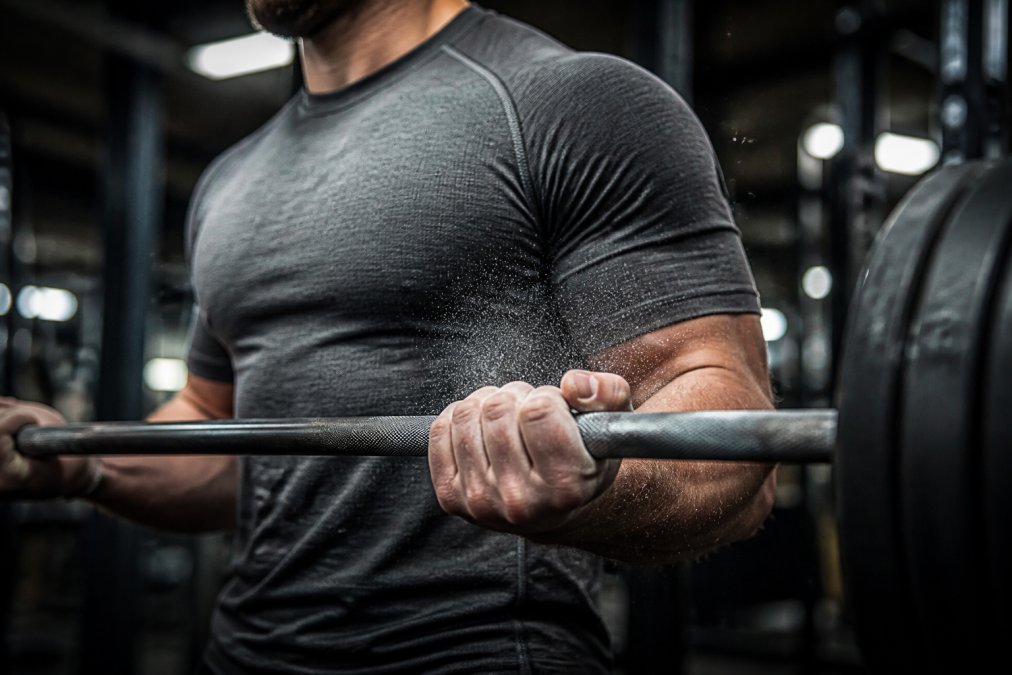
Fabric choice determines how long your powerlifting apparel lasts under load. Two properties matter most: how the fabric moves moisture, and how it resists mechanical wear.
Moisture-wicking describes a fabric that pulls sweat from your skin to the outer surface, where it dries faster. Synthetic blends like poly/spandex and tri-blend fabrics do this well; cotton does not. Cotton absorbs sweat, gets heavy, holds odor, and loses shape.
Abrasion resistance is how well a fabric resists surface wear from friction. Barbell knurling, belt edges, and platform contact all abrade fabric. Higher-denier synthetic blends survive this far better than thin cotton or low-quality knits.
What most guides miss: the failure point is usually the seam, not the fabric. Flatlock or reinforced stitching at the shoulder and crotch outlasts standard overlock stitching by a wide margin, and it is the first thing to check before you buy.
How to Choose Powerlifting Apparel for Your Body Type
Fit is not vanity in powerlifting. It is function. A garment that binds at the hip crease will stop you reaching depth. One that gaps at the shoulder will shift under a loaded bar. The problem is that most sizing charts assume an average body, and almost no lifter is average in every dimension.
Start with the lift that punishes bad fit the most, usually the squat. Measure your thigh circumference at the widest point and your natural waist, then size to the larger measurement. Powerlifting apparel should be snug without restricting range of motion. If you can feel the fabric pulling when you sit into a deep squat, it is too small.
Proportion-Driven Fit Problems (and How to Solve Them)
Long femurs. A long femur relative to your torso pushes your hips back and your torso forward in the squat. You need a singlet with enough torso length that the straps do not dig into your neck when you fold, and you will usually squat better in a raised-heel shoe to reduce the forward lean. In a singlet, look for a longer rise and a higher strap attachment.
Short femurs. The opposite problem: you tend to squat upright and can hit depth easily, but a singlet cut for a longer torso will bunch at the waist. Size down in the torso or choose a brand with a shorter rise. A flat shoe often suits this build better for squat because you do not need the extra ankle range.
Long torso. Straps sit high and can choke you at the bottom of a squat. Look for adjustable or stretch-panel straps, and test the singlet with a full-depth squat before you trust it. For the bench press, a long torso means the chest panel has more room to pull flat, check that the fabric still allows scapular retraction.
Short torso. The singlet rides up and the chest panel can feel tight across the collarbone. Size up in the torso, not the legs, and expect to need a slightly looser fit through the shoulders.
High hip-to-waist ratio. A wide hip and narrow waist makes waistbands roll and singlets pull down at the sides. A wide, flat waistband resists rolling better than a thin elastic one, and a singlet with side panels that follow the hip curve will stay put better than a straight-cut tube.
Narrow hips, thick thighs. The leg openings bind before the torso fits. Size to the thigh and accept a looser torso, or look for a cut with a gusseted crotch and tapered leg.
Belt Fit Is a Separate Measurement
Your belt size is not your pants size. Measure around your torso where the belt will actually sit, usually just above the hip bones for squat and deadlift, and add roughly an inch for a snug fit over a singlet and shirt. A belt that is too long leaves a tail that catches on the bar; too short and you cannot get it tight enough to brace. If you are between sizes, size up and use the tighter hole rather than sizing down and running out of adjustment.
Fit Adjustments for Waistbands, Shoulders, and Thighs
- Waistbands: A wide, flat waistband resists rolling better than a thin elastic one. If your waistband rolls during squats, the band is too narrow or the fit is too loose.
- Shoulders: For bench press, you need full scapular retraction. Test shoulder mobility in the shirt before you commit.
- Thighs: Tapered cuts follow the leg and reduce bunching at the hip crease. Straight cuts are more comfortable but can catch on the platform.
The Mayhem Classic Performance Tank ($44.99) uses a lightweight 4.2 oz tri-blend that moves with the shoulder without binding, which matters for bench setup. The Heavyweight Oversized T ($59.99) trades compression for unrestricted movement in a 7.5 oz fabric, useful for lifters who train in layers.

Classic Performance Tank
Training Apparel vs. Competition Gear: What Changes on Meet Day
Training apparel and competition gear serve different jobs. Training apparel absorbs volume: it takes chalk, sweat, and hundreds of reps. Competition gear has to pass inspection, fit under a singlet, and look sharp on the platform.
What changes on meet day:
- The singlet replaces your training bottoms entirely
- Accessories must be on the approved list
- Logos and branding face size limits
- Everything is checked at weigh-in, not after
Train in gear you can abuse. Compete in gear that is legal and predictable. The mistake is buying one set of clothes and expecting it to do both jobs well.
Conclusion
The gap between a lifter who is ready for the platform and one who is not often comes down to gear that was never checked against the rules. Getting powerlifting apparel right means reading your federation's rulebook, matching your shoes to your lifts, and choosing fabrics that survive repeated stress instead of looking good for a month.
Mayhem Performance Apparel builds for exactly that standard: apparel engineered to withstand relentless training, constructed from performance blends that hold up under load, and designed for athletes who train regardless of circumstance. Start with the Moisture Wick Short or the Classic Performance T, and build a rotation that lasts.

Frequently Asked Questions
What are the essential clothing requirements for powerlifting competitions?
Most federations require a singlet that fits snugly without being restrictive, a t-shirt under the singlet for bench press, and approved footwear. Knee sleeves, belts, and wrist wraps must meet specific thickness and length rules. Always check your federation's rulebook before buying gear, because requirements vary between organizations. Non-compliant gear can result in disqualification even if it performs well in training.
How should a powerlifting singlet fit for competition?
A competition singlet should fit tight enough to stay in place during a max squat but loose enough to allow full range of motion at the hips and shoulders. The leg openings should not ride up during a deadlift setup. If the singlet bunches at the crotch or restricts your arch on bench, size up. Tapered fits work well for most lifters, but body type matters more than any single size chart.
What is the difference between training apparel and competition gear?
Training apparel prioritizes durability, breathability, and comfort through repeated sessions. Competition gear must meet federation rules for thickness, length, and material. You might train in moisture-wicking shorts and a performance tee, then switch to a singlet and approved knee sleeves on meet day. Buying training gear that mimics competition fit helps you avoid surprises when it counts.
Why is fabric durability important for heavy-duty lifting?
Heavy lifting puts stress on seams, waistbands, and fabric at the shoulders and thighs. Cheap cotton blends stretch out, pill, or tear within months. Look for poly/spandex blends with abrasion resistance and reinforced stitching. Moisture-wicking fabrics also prevent sweat from weighing down the garment during long sessions, which keeps fit consistent from the first warm-up set to the last heavy single.
What should I look for in powerlifting socks and footwear?
For deadlifts, many federations require socks that cover the shin to prevent scraping. Footwear depends on your lift: heel elevation helps squats and bench, while a flat sole works better for deadlifts. Some lifters bring two pairs to a meet. Check that your shoes have non-slip soles and meet any federation height or sole thickness rules before you compete.
0 comments