
Table of Contents
- Why Gym Clothes Split at Seams: The Real Causes
- Why Do Leggings Rip in the Inner Thigh?
- Seam Construction, Placement, and Stitch Quality
- How to Repair a Split Seam in Leggings
- How to Prevent Leggings From Ripping
- How Long Should Workout Clothes Last?
- Frequently Asked Questions
Last Updated: October 18, 2026
Why Gym Clothes Split at Seams: The Real Causes
Most gym clothes split at seams because the seam takes more load than the fabric around it. Every squat, lunge, and sit-to-stand pulls on a narrow line of thread. When fit is too tight, the fabric can't stretch enough, so the seam absorbs the strain. Eventually, it gives.
At Mayhem Performance Apparel, we build gear for athletes who train under load, and we've learned that seam failure is rarely random. It follows patterns you can spot and prevent.
Below, we'll show you exactly what causes a split, how to tell a seam failure from a fabric tear, and how to fix or prevent both. First, here's what most guides get wrong: they blame cheap fabric. In practice, fit and seam construction matter just as much.
Gym clothes split for three core reasons: too much tension, too little ease, and weak seam construction. Fix those three and most rips never happen.
Mechanical Stress, Tension, and Fabric Stretch
Mechanical stress is the force your movement puts on a garment. Squatting, bending, and sitting all stretch fabric to its limit. The seam sits at the point of highest tension.
When fabric stretches, the stitches must stretch with it. Many seams use thread that doesn't flex as much as the fabric. That mismatch puts all the strain on a few stitches. One breaks, then another, and the seam opens.
A common mistake is sizing down for a "compression" feel. That squeezes the fabric past its stretch limit before you even move.
Fit, Garment Size, and Insufficient Ease
Ease is the extra room between your body and the fabric. Too little ease means the garment is already stretched when you stand still. Any movement pushes it past its limit.
Signs your fit is too tight:
- The waistband digs in and rolls down
- Fabric looks thin and pale across the thighs
- You feel pulling at the crotch or seat when you squat
- Seams pucker or ripple when you stand
Fit is the number one thing you control. A slightly roomier cut often lasts far longer than a tight one.
Why Do Leggings Rip in the Inner Thigh?
Leggings rip in the inner thigh because that area faces the most friction and the most stretch at once. Your thighs rub together with every step, and the fabric there stretches thin. Heat and sweat soften the fibers, and the seam takes the load.
Three forces combine in the inner thigh:
- Friction between the legs during running and walking
- Tension from the fabric stretching across the thigh
- Thinning as fibers wear down from repeated rubbing
Pilling is the early warning sign. If the inner thigh looks fuzzy or worn, the fabric is already thinning. A split usually follows.
Seam Construction, Placement, and Stitch Quality
Seam construction decides how well a garment handles stress. The core mechanism is load distribution: a seam that spreads force across many stitches and a wide seam allowance survives far more movement than one that concentrates force on a single line of thread.
How Seam Types Handle Load
- Flatlock seams join two fabric edges without a raised ridge. The stitch pattern interlaces thread across the seam, so tension spreads over a wider band. Flatlock is common on leggings and compression wear because it also eliminates the chafe ridge that rubs during running.
- Overlock (serged) seams wrap thread around the fabric edge to prevent fraying. They are fast and inexpensive but concentrate stretch at the stitch line. A basic overlock with no reinforcement is the most common failure point on inexpensive gym shorts.
- Coverstitch seams use two needle lines with a looping thread underneath. They stretch well and are often used on hems and waistbands, but a coverstitch that is too tight puckers and creates a stress riser.
- Double-stitched or reinforced seams add a second row of stitching at high-stress points like the crotch, seat, and rise. The second row shares the load and slows the cascade that starts when one stitch breaks.
The Stitch-to-Fabric Stretch Mismatch
The most common construction failure is a thread that stretches less than the fabric it joins. Performance knits often stretch 50 percent or more across the thigh. If the seam thread stretches only 20 percent, the thread reaches its limit first and snaps, then the neighboring stitches follow. That is why a seam can pop even when the fabric around it looks new. Look for seams described as stretch-matched or sewn with textured polyester or nylon thread rather than cotton or basic polyester.
Seam Placement and Friction
Seam placement matters as much as seam type. A seam running straight through the crotch or inner thigh takes direct friction from leg rub and from equipment contact. Better designs move seams away from rub points, for example, a gusseted crotch that removes the center seam entirely, or an offset inseam that shifts the seam line off the highest-friction zone. When you shop, turn the garment inside out and check where the seams sit relative to your inner thigh and seat.
How to Inspect Seams Before You Buy
Use this inspection routine in the fitting room or when your order arrives:
- Turn the garment inside out and look for loose thread tails, skipped stitches, or puckering along the seam line.
- Stretch the seam gently across its width. A well-built seam recovers; a weak one shows gaps between stitches or a thread that stays straight while the fabric stretches.
- Check that high-stress points, crotch, seat, rise, and inner leg, have a second row of stitching or a reinforcement patch.
- Run a thumb along the seam to feel for a raised ridge that will rub during movement.
- Confirm the seam allowance is wide enough that the fabric edge is fully enclosed, not fraying inside the stitch line.
A seam that fails inspection before you train will fail under load. Construction is one of the few quality signals you can verify in seconds.
How to Repair a Split Seam in Leggings
You can repair a split seam in leggings in about 15 minutes with a needle and strong thread. Repair works best when the fabric around the seam is still intact.
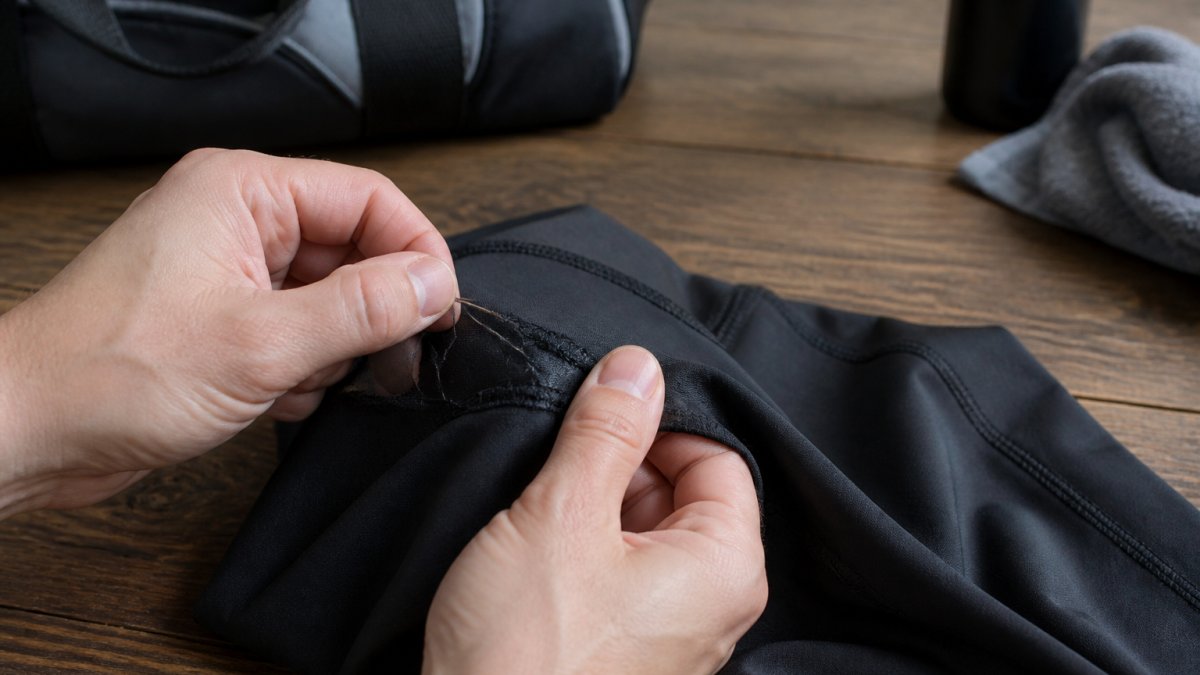
Steps to fix a split seam:
- Turn the leggings inside out and find the open seam
- Pin the seam edges together so they line up
- Thread a needle with polyester or nylon thread that matches the fabric
- Stitch a tight backstitch along the original seam line
- Knot the thread and trim the tail
- Turn right side out and gently stretch to test the repair
For a quick fix, a fabric-safe adhesive works on small splits. It won't last as long as stitching, but it gets you through a session.
Replace the garment when the fabric around the seam is thin, pilled, or torn. Re-stitching worn fabric just moves the failure a few inches over.
How to Prevent Leggings From Ripping
You prevent leggings from ripping by buying the right fit, choosing strong seam construction, and caring for the fabric. Prevention starts before you ever put them on.
To prevent rips:
- Size for movement, not compression
- Choose flat, reinforced seams at high-stress points
- Avoid fabric that feels thin across the thighs
- Rotate your gear instead of wearing one pair daily
- Wash on cold and skip the dryer
Assessing Sizing and Fit Before You Buy
Check fit before you buy by testing movement, not just measurements. Squat, lunge, and sit in the fitting room or check the size chart against your measurements.
Use this checklist:
- Fabric doesn't look pale or thin when you squat
- Waistband stays put without rolling
- No pulling at the crotch or seat
- Seams lie flat and don't pucker
- You can move through a full range of motion
If a pair feels tight standing still, it will fail under load.
How Long Should Workout Clothes Last?
Workout clothes should last one to two years with regular training and proper care. Heavy daily use shortens that. Rotation and correct washing stretch the lifespan.
How long depends on:
- Training frequency: daily use wears gear faster
- Fabric quality: denser, stretch-matched fabric lasts longer
- Fit: a proper fit reduces strain on seams
- Care: cold washing and air drying add months
When seams keep splitting and fabric thins across the thighs, it's time to replace. Patching a worn garment only delays the next rip.
Laundry and Care for Technical Fabrics
Care for technical fabrics by washing cold, using mild detergent, and air drying. Skip fabric softener, which coats fibers and blocks moisture wicking.
Care rules that protect seams and stretch:
- Turn garments inside out before washing
- Use cold water and a gentle cycle
- Skip the dryer or use low heat
- Air dry flat or hang to protect stretch
- Wash with similar fabrics to reduce abrasion
Good care keeps fabric stretch intact. When stretch holds, seams stay protected.
At Mayhem Performance Apparel, we build gear for athletes who train under load. Our Moisture Wick Track Pants use a lightweight poly/spandex blend with four-way stretch and durable construction for consistent training. The Moisture Wick Shorts use a 90% polyester, 10% spandex blend with four-way stretch for unrestricted movement.


Frequently Asked Questions
Can tight workout clothes cause seams to split?
Yes. When gym clothes fit too tightly, the fabric has no room to stretch with your movement, so the seam takes the full load instead. Squatting, bending, and sitting force the stitching to pull against tension it was not built to handle. Choosing the right size with enough ease, especially through the seat and thighs, spreads that stress across the fabric rather than concentrating it on one seam line.
Can a split seam in activewear be repaired?
Most split seams in activewear can be repaired if the fabric around the seam is still intact. Turn the garment inside out, match the original seam line, and use a stretch stitch or a zigzag stitch on a sewing machine so the repair can move with the fabric. A hand-sewn backstitch with polyester thread works for small openings. If the fabric itself has thinned or torn, repair is usually temporary and replacement makes more sense.
Does washing workout clothes make seams weaker?
Repeated washing can weaken seams over time, mainly through heat and agitation. Hot water and high-heat dryer cycles break down elastic fibers and shrink synthetic fabrics, which puts extra tension on stitching. Wash technical fabrics in cold water, skip fabric softener, and air dry or use low heat. Turning garments inside out and using a mesh laundry bag also reduces friction against the seam lines.
What type of seam is strongest for workout clothes?
Flatlock and coverstitch seams generally hold up best for training apparel because they lie flat against the skin and distribute tension across multiple rows of stitching. Double-needle stitching with reinforced stress points also performs well. Look for bar tacks or reinforced stitching at high-stress areas like the crotch, inner thigh, and waistband, since those points take the most mechanical stress during squats and lunges.
Splits and rips come down to three things: fit, seam strength, and fabric care. Get those right and your gear lasts. At Mayhem Performance Apparel, we engineer apparel to withstand relentless stress, with four-way stretch fabric and durable construction built for repeated training. If you're tired of gear that quits mid-session, shop now and train in apparel built to endure.
0 comments