
Table of Contents
- Are Expensive Workout Clothes Worth the Cost? The Honest Answer
- What Actually Drives the Price Up
- Budget vs. Premium Gym Clothes: A Direct Comparison
- Cost Per Wear Activewear: The Math That Changes Everything
- Best Workout Clothes for Durability: What to Look For
- Performance Features That Matter vs. Features That Don't
- Affordable Workout Clothes: Where to Save Without Sacrificing Quality
- Care Practices That Extend the Life of Your Gear
- Conclusion: How to Decide What's Worth It for You
- Frequently Asked Questions
Last Updated: October 5, 2026
Are Expensive Workout Clothes Worth the Cost? The Honest Answer
Are expensive workout clothes worth the cost? The honest answer is sometimes yes, and often no. It depends on how hard you train, how often you wash your gear, and whether you are buying performance or buying a logo. At Mayhem Performance Apparel, we build gear for athletes who train under load, so we have a bias toward durability. But we will also tell you when a cheaper option is the smarter buy.
Here is the framework we use: price only matters when it maps to something measurable. Fabric weight, seam construction, and how a garment holds up after fifty washes decide whether you got value. The rest is marketing.
FTC guidance on textile labeling and fiber content requires brands to disclose fiber content and country of origin, which gives you a factual starting point when comparing labels.
Below, we break down what actually drives price, compare budget and premium garments directly, and show you the cost-per-wear math that settles most arguments.
What Actually Drives the Price Up
Four things separate a $15 tee from a $60 one: fabric quality, construction, fit engineering, and brand positioning. Only the first three affect performance.
Fabric is the biggest cost lever. A heavyweight cotton tee uses more raw material and holds its shape longer than a thin blend. Performance knits with spandex cost more per yard but stretch and recover instead of sagging. Construction matters just as much: flatlock seams, reinforced collars, and side-seam panels add labor cost but prevent the failures you actually notice, like twisted hems and blown-out armpits.
Brand positioning is the wildcard. Some of what you pay goes to sponsorship deals, retail markups, and lifestyle marketing. That is not automatically bad, but it is not durability either.
Budget vs. Premium Gym Clothes: A Direct Comparison
The real difference between budget and premium gym clothes shows up in three areas: how they fit during movement, how they handle sweat, and how long they last. Budget gear can pass on all three for light use. Premium gear earns its price under repeated heavy training. The table below breaks the trade-offs down by the factors that actually change how a garment performs, not by how it looks on a hanger.
Factor |
Budget Gear |
Premium Gear |
Why It Matters |
|---|---|---|---|
Fabric weight |
Often 3.5-4.5 oz/yd² knits |
Commonly 5-7.5 oz/yd² knits |
Heavier knits resist thinning, pilling, and see-through stretches |
Fiber blend |
High cotton or basic polyester, low spandex |
Poly/spandex or nylon/spandex with 12-20% elastane |
More spandex means better stretch recovery and less sagging at knees and waistbands |
Seam construction |
Basic overlock, single-needle hems |
Flatlock seams, double-needle collars, gusseted crotches |
Flatlock lies flat against skin and resists fraying at stress points |
Sweat handling |
Slower to dry, holds odor |
Moisture-wicking, quick-drying, often odor-treated |
Wet fabric chafes and cools you down between sets |
Waistband |
Elastic only |
Elastic plus internal drawcord or bonded panel |
Drawcords keep shorts in place during squats and deadlifts |
Lifespan under heavy use |
Often 6-18 months before pilling or stretch loss |
Often 2-4 years with proper care |
The gap widens the more you train per week |
Best for |
Light, occasional training, warm-up layers |
Daily, high-stress sessions, load-bearing movements |
Match spend to where the stress lands |
A common mistake is buying premium tops and budget bottoms, or the reverse. Match the spend to where the stress lands. If you squat and deadlift weekly, your shorts and waistbands take the beating, that is where flatlock seams, a gusseted crotch, and a real drawcord pay off. If you run, your tops and socks matter more, because chafing and sweat management drive comfort over distance.
A second mistake is assuming price equals performance. Some premium pricing goes to colorways, collaborations, and lifestyle marketing rather than fabric or construction. The way to tell the difference is to read the spec sheet: fabric weight, fiber percentages, and seam type are the three numbers that separate a garment built for training from one built for a photo shoot.
Textile Exchange materials market reporting tracks how fiber choices affect both durability and environmental footprint, which is worth knowing before you buy.
Cost Per Wear Activewear: The Math That Changes Everything
Cost per wear is the price of a garment divided by the number of times you actually wear it. A $60 shirt worn 100 times costs $0.60 per wear.
That is the simple version. The useful version accounts for how often you train, how many pieces you rotate, and how long each piece actually lasts.
Step 1: Count your sessions per week. A lifter training four days a week wears roughly 200 tops and 200 bottoms per year. A casual gym-goer training twice a week wears about 100 of each.
Step 2: Count how many pieces you rotate. If you own five training tops and train 200 times a year, each top gets worn about 40 times per year.
Step 3: Estimate realistic lifespan. This is where budget and premium diverge.
Step 4: Divide. A $60 top that survives 150 wears costs $0.40 per wear. A $20 top that survives 40 wears costs $0.50 per wear.
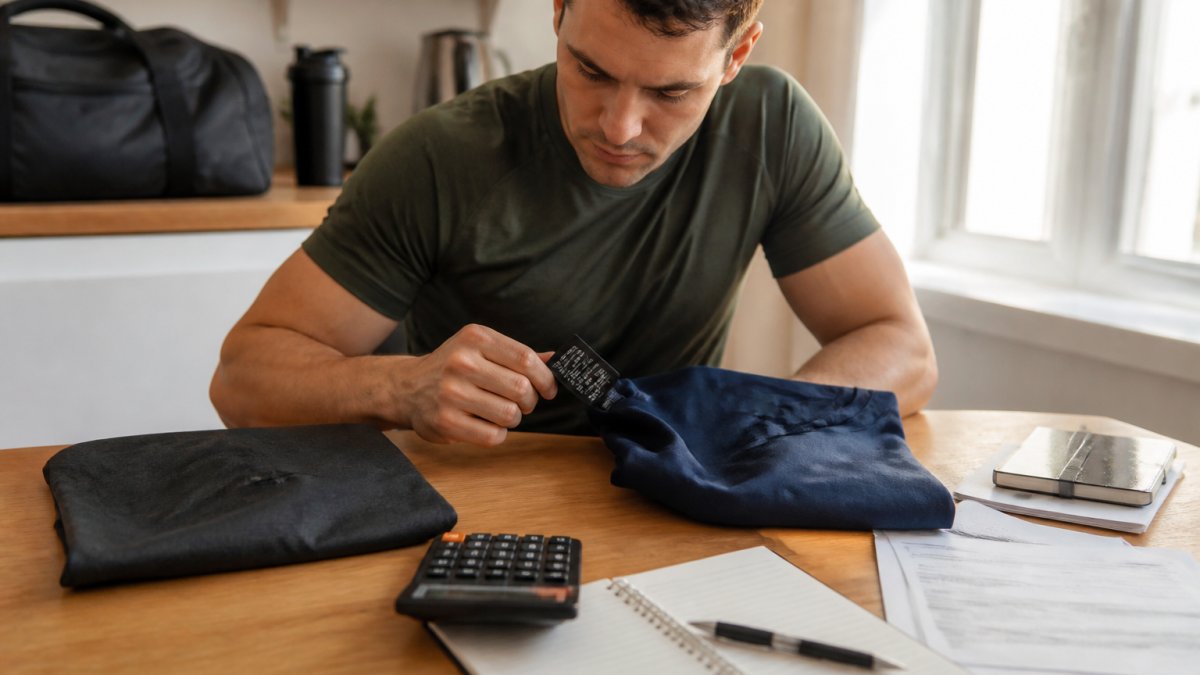
A person in athletic wear examining a clothing tag while comparing two folded workout shirts side by side on a wooden table, soft natural window light, focused expression
The break-even question. The math only favors premium gear when you train enough to wear it out.
What the math does not capture. Cost per wear ignores fit, comfort, and how often you actually reach for a piece.
Best Workout Clothes for Durability: What to Look For
Durability comes down to fabric weight, stitch quality, and how a garment is cut. Look for heavier knits, reinforced stress points, and seams that lie flat instead of bunching.
Fabric Weight, Stitching, and Seams
Fabric weight tells you how much material you are getting. Heavier fabrics resist thinning and hold their shape through repeated washing. Stitching tells you how well it is held together. Double-needle stitching at the collar and flatlock seams at the shoulders and crotch are the marks of gear built to last.
Our Classic Performance T uses a lightweight breathable performance fabric with moisture-managing properties and a tagless design, built for repeated training and washing. If you prefer a heavier feel, the Heavyweight Oversized T uses 7.5 oz cotton with a reinforced double-needle stitched collar, which is the kind of construction that survives years of use.

Classic Performance T
Check three spots before you buy:
- Collar and neckline for reinforcement
- Crotch and shoulder seams for flatlock stitching
- Waistband for an internal drawcord instead of elastic alone
Performance Features That Matter vs. Features That Don't
Moisture-wicking, breathability, and stretch genuinely affect how you perform. Compression claims, "energy" fabrics, and most aesthetic details do not.
Moisture-Wicking, Breathability, and Sweat Management
Moisture-wicking is the ability of a fabric to pull sweat away from your skin and spread it across the surface so it evaporates faster. Breathability is how easily air passes through the fabric to release heat. Both matter most in hot conditions and long sessions.
Synthetic blends handle sweat better than cotton. Cotton absorbs moisture and gets heavy, which is why it is a poor choice for intense training. Our Moisture Wick Shorts use a 3.5 oz poly/spandex blend with four-way stretch and a 7-inch inseam, and our Moisture Wick Track Pants use a 7.8 oz poly/spandex blend with zippered pockets and ankle zippers. The Classic Performance Tank uses a 4.2 oz polyester, cotton, and modal tri-blend with side-seam construction for shape retention.


Features that rarely earn their markup:
- Compression panels marketed as recovery aids
- "Far-infrared" or mineral-infused fabrics
- Premium pricing tied only to colorway or collaboration
Affordable Workout Clothes: Where to Save Without Sacrificing Quality
You can build a functional training wardrobe on a budget if you know where to cut. Save on tops and accessories. Spend on bottoms, socks, and anything that carries load.
Affordable workout clothes make sense for low-impact training, warm-up layers, and casual wear. Spend more on the pieces that take stress: shorts, track pants, and tops you wear for every session. Buy two or three quality pieces instead of six cheap ones, and rotate them so each garment gets rest between washes.
EPA information on textile waste reduction notes that extending the life of clothing is one of the most effective ways to cut textile waste, which is another argument for buying fewer, better pieces.
If you want to test a brand before committing, start with one item you will train in weekly. If it holds shape and color after a month of hard use, the rest of the line is likely worth it.
Care Practices That Extend the Life of Your Gear
How you wash your gear matters as much as what you buy. Most premature failures come from heat, fabric softener, and the dryer, not from training.
Follow these habits:
- Wash cold on a gentle cycle to protect stretch fibers
- Skip fabric softener, which coats performance fabrics and blocks wicking
- Air dry when possible; heat breaks down spandex and elastic
- Turn garments inside out to reduce surface abrasion
- Wash immediately after heavy sweat sessions to prevent odor retention
A common mistake is treating performance wear like everyday cotton. Hot water and high heat shorten the life of any garment, cheap or expensive. Care is the cheapest durability upgrade available.
Conclusion: How to Decide What's Worth It for You
The honest answer to whether expensive workout clothes are worth the cost comes down to frequency and stress. If you train hard four or more days a week, premium gear usually wins on cost per wear within a year. If you train lightly, budget options cover most of what you need.
At Mayhem Performance Apparel, we build for the first group. Our gear is engineered to withstand relentless training, with moisture-wicking fabrics, durable construction, and fits designed for athletes who operate under load. It is not a lifestyle brand. It is built for performance under repeated stress.
Shop now and get gear that endures as long as you do.
Frequently Asked Questions
Do expensive workout clothes last longer than budget options?
They often do, but it depends on construction rather than price alone. Look for reinforced stitching, heavier fabric weights, and moisture-wicking blends that hold their shape after repeated washing. A $50 performance tee with durable construction can outlast a $20 option that pills and loses elasticity within months. The key is checking fabric weight, seam quality, and care instructions before buying.
What should I look for when buying workout clothes for durability?
Focus on three things: fabric weight, stitching quality, and moisture management. Heavier fabrics like 7.5 oz cotton hold up better under repeated wear, while poly/spandex blends resist stretching. Check for double-needle stitched collars and side-seam construction, which prevent shape loss. Tagless designs also reduce irritation during long training sessions. These construction details matter more than brand name for long-term durability.
How much should I spend on workout clothes?
There is no single right number, but cost per wear is the best measure. If you train four times a week, a $50 shirt worn for a year costs roughly 24 cents per session. A $20 shirt that falls apart in three months costs more per wear. Calculate how often you will use the item, then divide the price by estimated wears. For high-frequency training, spending more upfront often costs less over time.
Is expensive activewear more comfortable?
Comfort depends on fit and fabric, not price. Premium activewear often uses four-way stretch fabrics, tagless designs, and moisture-wicking technology that reduce chafing and keep you dry. Budget options can be comfortable too, but they may use heavier cotton that traps sweat or lack stretch for full range of motion. Try garments that match your specific activity, whether that is lifting, running, or conditioning work.
0 comments