
Table of Contents
- What Separates Real Gym Shorts From Everything Else
- The Five Specs That Decide Performance
- Fabric and Construction: What Survives a WOD
- Best CrossFit Shorts for Men: Fit, Inseam, and Waistband
- Best CrossFit Shorts for Women: Coverage Without Ride-Up
- Compression Shorts for CrossFit: When the Second Layer Earns Its Place
- CrossFit Shorts With Liner: Built-In Support or Skip It
- Mistakes That Cost You Mid-Workout
- Conclusion
- Frequently Asked Questions
Last Updated: October 20, 2026
What Separates Real Gym Shorts From Everything Else
The best gym shorts for intense CrossFit are not the cheapest pair that fits. They are the pair that survives a full WOD without riding up, chafing, or stretching out of shape. At Mayhem Performance Apparel, we build gear for athletes who train under load and expect it to hold. Most shorts fail on one of five specs: inseam, fabric weight, stretch recovery, waistband construction, and sweat handling. Get those right and a pair lasts through years of burpees, box jumps, and heavy squats.
Below, we break down what to look for, how men's and women's fits differ, and when a compression layer earns its place.
The Five Specs That Decide Performance
Five specifications determine whether gym shorts hold up in a WOD or fall apart under stress.
- Inseam: A 5-inch inseam frees the knee for squats but rides up on box jumps. A 7-inch inseam balances coverage and mobility.
- Fabric weight: Lightweight performance blends move sweat off the skin. Heavy cotton gets wet and stays wet.
- Stretch recovery: Four-way stretch lets you hit full depth. Recovery matters more, because shorts that stay stretched sag mid-session.
- Waistband: An elastic waist with an internal drawcord stays locked through Olympic lifts. A loose band rolls under load.
- Lining: Built-in support removes a layer. Unlined shorts need compression underneath for high-impact work.
The American Council on Exercise guide to workout clothing makes a related point: fabric choice affects comfort and thermoregulation during training.
Fabric and Construction: What Survives a WOD
Fabric construction is where cheap shorts expose themselves. A poly/spandex blend with moisture-wicking technology handles sweat management and quick drying. Cotton holds moisture, gets heavy, and chafes against skin during high-repetition work.
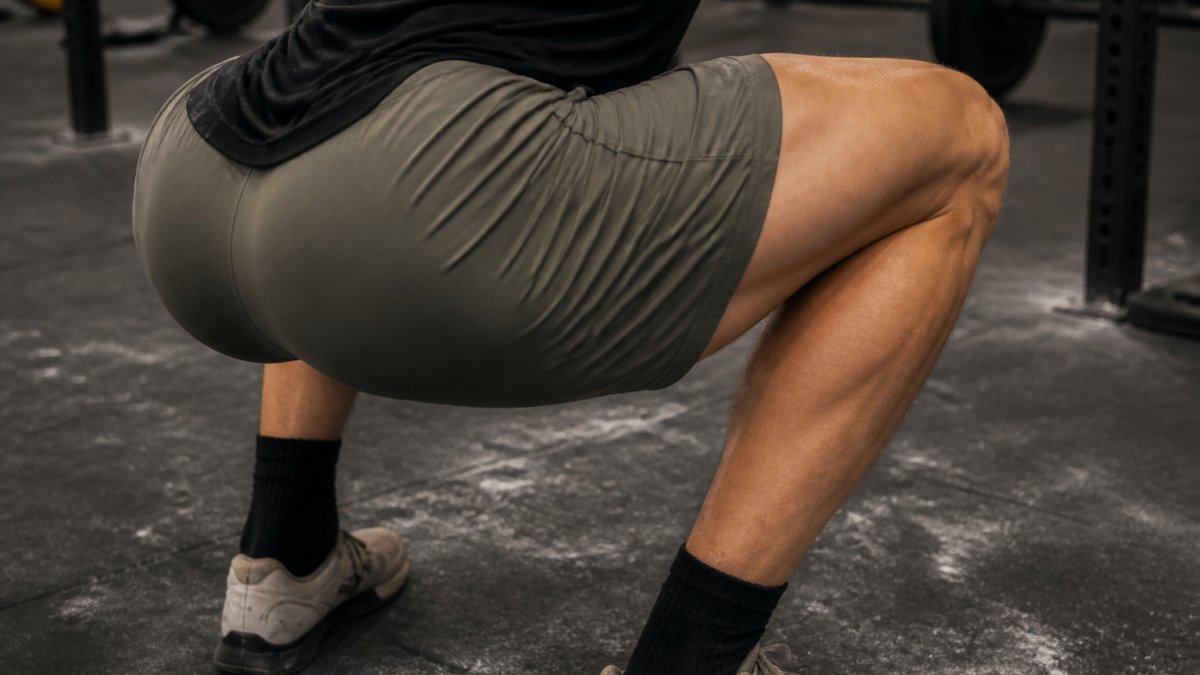
Our Moisture Wick Shorts use a 3.5 oz 90% polyester / 10% spandex blend. That weight is light enough for breathability and heavy enough to resist pilling from rope climbs. Four-way stretch supports full range of motion.

Care matters too. Skip fabric softener, which coats performance fibers and reduces wicking. Wash cold and hang dry to protect stretch recovery.
Best CrossFit Shorts for Men: Fit, Inseam, and Waistband
Men's fit comes down to three decisions: inseam, waistband, and cut through the thigh. Most practitioners find that a 7-inch inseam gives enough coverage for squats and lunges without catching on the knee, while a 5-inch inseam suits athletes who prioritize mobility and don't mind more thigh exposure.
For heavy lifting, the waistband is the failure point. An elastic waist with an internal drawcord keeps shorts anchored through Olympic lifting and deadlifts. A band without a drawcord rolls down once you add a belt. Look for a band that is at least 1.5 inches tall and lined so it doesn't dig in when you set up for a clean.
Movement-by-movement fit check
Rather than trusting a size chart alone, test these five movements before a hard session:
- Air squat: The short should clear the thigh without pulling tight across the hip. If the waistband lifts off your lower back at the bottom, the rise is too short.
- Box jump: A 5-inch inseam rides up on landing; a 7-inch inseam stays closer to the thigh. Check that the hem doesn't catch on the box edge.
- Burpee: The short should not balloon open at the waist when you drop to the floor. A drawcord cinched snug prevents gapping.
- Olympic lift: With a belt on, the waistband should sit below the belt line, not bunch under it. A lower-rise short works better here than a high-rise one.
- Rope climb: Run the fabric between thumb and forefinger along the inner thigh. A smooth, tight weave resists abrasion; a loose knit pills and snags.
Size-chart interpretation
A common mistake is sizing up to avoid thigh tightness. That leaves the waistband loose, and the shorts slide down mid-WOD. Size to your waist measurement first, then check the thigh opening against your measured thigh circumference with about 1 inch of ease. If you are between waist sizes, choose the smaller waist and confirm the thigh opening is at least 1 inch larger than your thigh measurement. Many brands publish a thigh or leg-opening measurement; if they don't, treat that as a signal the fit is less predictable.
Cut through the thigh
Look for a cut that clears the thigh without ballooning. Baggy shorts catch on bars and kettlebells. Too-tight shorts restrict the squat. A tapered leg, wider at the hip, narrower at the hem, is the safest middle ground for mixed training. If you have larger thighs relative to your waist, prioritize a short with a higher spandex content (roughly 10% or more) so the fabric recovers instead of staying stretched.
Best CrossFit Shorts for Women: Coverage Without Ride-Up
Women's fit lives or dies on ride-up. Shorts that creep up during running and box jumps force constant adjustment. The fix is a combination of inseam length, a secure waistband, and a fabric that holds its shape. A 5- to 7-inch inseam reduces ride-up on high-impact movements. Compression fit helps, but not every athlete wants a second-skin feel for every session. Many women pair unlined shorts with a compression layer for high-intensity days and wear them alone for lifting.
Movement-by-movement coverage check
Test these five movements before committing to a pair:
- Squat: The hem should stay at or above mid-thigh without creeping toward the hip crease. If the short rides up past mid-thigh at the bottom, size up in inseam, not in waist.
- Box jump: Land and check whether the hem has migrated. A 5-inch inseam often moves 1-2 inches on landing; a 7-inch inseam moves less.
- Burpee: The waistband should stay flat against the lower back when you drop to the floor. A high-rise band with a drawcord prevents gapping.
- Kettlebell swing: The short should not twist at the waist through the hinge. A wide, flat waistband distributes tension better than a narrow elastic band.
- Double-under: Check for thigh rub. A longer inseam or a compression liner reduces chafing across high-repetition jumping.
Size-chart interpretation and body-shape notes
Coverage at the waist matters too. A high-rise elastic waist with a drawcord stays put through burpees and kettlebell swings. When reading a size chart, measure your natural waist and your hip at the widest point, then compare both to the chart rather than choosing by waist alone. If your hip measurement falls in a larger size than your waist, choose the hip size and use the drawcord to secure the waist. If your waist falls in a larger size than your hip, choose the waist size and confirm the thigh opening is wide enough for a squat without pulling.
For athletes with a shorter torso, a mid-rise short often sits better than a high-rise; for a longer torso, a high-rise short prevents the waistband from sliding below the hip crease during hinges. Test the squat in the fitting room or read the return policy before ordering online.
Lined versus unlined for women
Lined shorts reduce the need for a separate compression layer and cut down on bunching during high-impact work. Unlined shorts give more flexibility for lifting days when a second-skin feel is unnecessary. Whichever you choose, confirm the liner uses the same moisture-wicking fabric as the shell, a cotton liner defeats the purpose and holds sweat against the skin.
Compression Shorts for CrossFit: When the Second Layer Earns Its Place
Compression shorts for CrossFit reduce muscle oscillation and chafing during high-repetition work. The second-skin fit also prevents thigh rub on long runs and protects skin from bar contact during cleans.
They earn their place in three scenarios: high-volume conditioning, running-heavy WODs, and any session with repeated bar contact. For pure strength work, many athletes prefer a looser training short.
The trade-off is heat. A compression layer adds warmth, which helps in cold gyms and hurts in hot ones. Pair compression shorts with a lightweight outer short rather than doubling up on heavy fabric.
CrossFit Shorts With Liner: Built-In Support or Skip It
CrossFit shorts with liner combine the outer short and support layer into one piece. The upside is fewer layers, less bunching, and faster transitions. The downside is less flexibility: you can't remove the liner on a hot day.
Lined shorts suit athletes who want one-and-done simplicity for daily training. Unlined shorts suit athletes who mix lifting and conditioning and want to adjust layers.
Whichever you pick, check that the liner uses the same moisture-wicking fabric as the shell. A cotton liner defeats the purpose.
Mistakes That Cost You Mid-Workout
Most gear failures trace back to a few avoidable mistakes.
- Buying on price alone. Cheap shorts stretch out and chafe. Durability is the real value metric.
- Ignoring the drawcord. A loose waistband rolls under a lifting belt.
- Wearing cotton. Cotton holds sweat and gets heavy during conditioning.
- Skipping the squat test. Always confirm range of motion before a hard session.
- Over-washing with softener. It kills wicking performance over time.
| Mistake | Fix | Impact |
|---|---|---|
| No drawcord | Choose elastic waist with internal drawcord | Waistband stays locked |
| Cotton fabric | Pick poly/spandex blend | Faster drying, less chafe |
| Wrong inseam | Match inseam to movement | Less ride-up |
| Fabric softener | Wash cold, hang dry | Preserves wicking |
Conclusion
Finding the best gym shorts for intense CrossFit comes down to fabric, fit, and hardware that survives repeated stress. Our Moisture Wick Shorts are built for exactly that: a 3.5 oz poly/spandex blend, four-way stretch, moisture-wicking technology, and a 7-inch inseam with an internal drawcord, priced at $49.99. They're designed to endure relentless training, not just a few sessions. Control the chaos and train in gear that holds up as long as you do.
Shop now →
Frequently Asked Questions
What should I look for in CrossFit shorts?
Prioritize four-way stretch fabric, a flat waistband that stays put under a belt, and an inseam that clears your thigh without bunching. A poly/spandex blend of roughly 90/10 wicks sweat and dries fast. Check for an internal drawcord so the waist does not shift during burpees or box jumps. Lined options add support if you skip a base layer. Skip cotton, which gets heavy and holds odor through repeated sessions.
Are 5-inch or 7-inch shorts better for CrossFit?
It depends on your build and the movement. A 7-inch inseam, like the Mayhem Moisture Wick Shorts at $49.99, balances coverage and mobility for lifting, conditioning, and running. Test in a WOD with burpees and wall balls, since those expose ride-up fastest.
Are compression shorts good for CrossFit?
Yes, as a base layer. Compression shorts for CrossFit reduce chafing on rope climbs and high-rep squats, and they hold muscle in place through Olympic lifts. Wear them under looser training shorts rather than alone if your box requires coverage. Look for a second-skin fit that does not restrict range of motion at the hip.
How do I keep workout shorts from riding up during training?
Ride-up usually comes from a loose leg opening or slick fabric against bare skin. Choose shorts with a slightly tapered leg and enough stretch to move with your hip angle. Wearing a compression layer underneath gives the outer short something to grip. Also check sizing: shorts that are too big slide up more than snug ones. Test with air squats before a heavy session.
0 comments