
Table of Contents
- Why Durable Workout Gear Matters for Men Over 40
- Quick Comparison: Best Durable Workout Gear
- Best Workout Clothes for Men Over 40: Top Picks
- Durable Men's Workout Clothes: What to Look For
- Comfortable Workout Clothes for Older Men: Fit and Feel
- How to Make Your Gear Last: Care and Durability
- The Verdict: Choosing Gear That Endures
- Frequently Asked Questions
Last Updated: October 9, 2026
Why Durable Workout Gear Matters for Men Over 40
Durable workout gear is apparel built to survive repeated training sessions, frequent washing, and years of heavy use without losing its shape, fit, or function. For men over 40, that matters more than it did at 25: recovery takes longer, joints need more support, and replacing worn-out gear every few months gets old fast.
At Mayhem Performance Apparel, we build gear for athletes who train under load and refuse to negotiate with their standards. Cheap activewear fails at the seams, the waistband, and the fabric face first, and when that happens mid-training-block, you're back to square one on fit and feel.
Below, we break down what holds up, how to spot weak construction before you buy, and which pieces earn their place in a serious lifter's rotation.
Quick Comparison: Best Durable Workout Gear
Here is how our core pieces stack up on price, fabric, and best use, all built for repeated training and heavy washing cycles.
| Product | Price | Fabric | Best For |
|---|---|---|---|
| Moisture Wick Shorts | $49.99 | 3.5 oz poly/spandex, 4-way stretch | Heavy lifting, conditioning |
| Classic Performance T | $49.99 | Lightweight technical fabric, UV protection | Strength training, outdoor work |
| Midweight Fleece Joggers | $59.99 | 8.25 oz cotton blend, 3-end fleece | Recovery days, cold-weather training |
None of these are the lightest or cheapest option on the shelf. They are the ones that survive a training year.

Best Workout Clothes for Men Over 40: Top Picks
The best workout clothes for men over 40 prioritize fit stability, moisture management, and construction that survives repeated stress. Three pieces cover almost every scenario: shorts for heat and mobility, a performance tee for daily sessions, and joggers for recovery and cold.
Moisture Wick Shorts
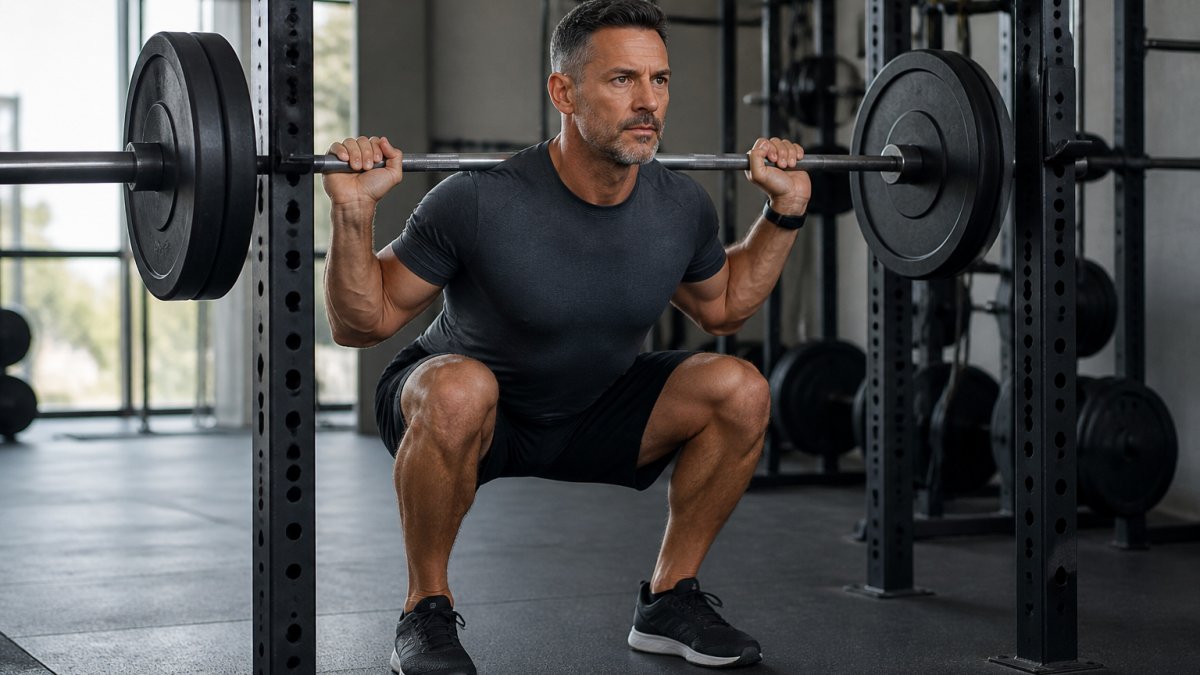
Our Moisture Wick Shorts ($49.99) are the workhorse for anyone training in heat or sweating heavily. The 3.5 oz poly/spandex blend moves sweat off your skin and dries fast, unlike cotton gear that turns heavy and sour mid-session. Four-way stretch and a 7-inch inseam give full range of motion through deep squats and lunges without riding up, and an internal drawcord keeps the waistband locked in place.
Where it falls short: the lightweight fabric is built for breathability, not abrasion resistance against rough surfaces. If you train on turf or drag sleds, expect normal wear at contact points.
Classic Performance T
The Classic Performance T ($49.99) is the daily driver. Lightweight technical fabric manages moisture, the tagless collar eliminates neck irritation, and built-in UV protection covers outdoor sessions. The athletic fit stays close without restricting overhead pressing or pulling.
The honest limitation: it is a performance tee, not a heavyweight cotton shirt. If you want a structured, boxy look, size up or pair it with the oversized cut.
Midweight Fleece Joggers
For recovery days and cold-weather training, the Midweight Fleece Joggers ($59.99) are the pick. The 8.25 oz cotton blend with a 100% cotton face feels soft, while the tightly knit 3-end fleece resists the pilling and thinning that kills cheaper joggers. An elastic waistband with drawstring and ribbed tapered cuffs keep the silhouette clean and in place.
Durable Men's Workout Clothes: What to Look For
Durable men's workout clothes share four traits: adequate fabric weight, reinforced seams, stretch recovery, and a waistband that doesn't roll. Skip one and the garment fails early.
Here is what to check before you buy:
- Fabric weight and blend. Heavier knits hold shape longer. Look for explicit ounce specs, not vague "premium" claims.
- Seam construction. Double-needle stitching at stress points (collar, cuffs, side seams) prevents blowouts.
- Stretch recovery. Four-way stretch that springs back keeps fit consistent after repeated wear.
- Waistband design. Elastic plus an internal drawcord beats elastic alone, especially during heavy squats.
- Odor control and quick-drying. Synthetic blends dry faster and resist the smell buildup cotton develops.
Comfortable Workout Clothes for Older Men: Fit and Feel
Comfortable workout clothes for older men come down to fit that moves with the body, not against it. As training experience grows, most lifters want less restriction, more coverage, and zero chafing, not tighter cuts.
Here is how to think about it in practice.
Start with three measurements, not a size label. Chest at the fullest point, natural waist (at or just above the navel, not where your jeans sit), and hip at the widest point.
Match the rise to the movement. Low-rise waistbands sit below the hip bone and migrate downward during hinging movements like deadlifts and bent-over rows.
Build-specific fit notes:
- Broader chest, narrower waist. Look for gusseted underarms or a raglan sleeve seam. Standard set-in sleeves pull across the back during overhead pressing when the chest-to-waist drop is more than about 8 inches.
- Fuller midsection. Choose a straight or relaxed cut through the torso rather than a tapered athletic cut. Tapered tees ride up over the belly during overhead work and expose the lower back.
- Longer torso. Check the body length spec, not just the size. A tee that ends at the hip bone will expose your lower back on every overhead rep. Look for a body length that reaches at least mid-fly.
- Shorter inseam needs. A 7-inch inseam on shorts works for most builds; a 5-inch inseam is better if you are under about 5'9" and want full knee clearance on squats.
- Thigh-to-waist ratio. If your thighs measure close to or larger than your waist, size shorts and joggers to the thigh and use the drawcord to manage the waist. Sizing to the waist will bind at the quad.
Big-and-tall sizing should be a first-class option, not an afterthought. The test is whether the brand publishes separate spec sheets for extended sizes rather than grading a standard pattern up.
What most guides miss is that comfort and durability are not opposites. A heavyweight cotton tee or an 8.25 oz fleece jogger can feel great and last for years if the construction is right.
How to Make Your Gear Last: Care and Durability
Gear lasts longer when you treat washing as part of training. The biggest killer of activewear is heat: hot water and high dryer settings break down elastic, shrink cotton, and accelerate pilling. Once you understand what is actually failing, the care decisions become obvious.
What actually breaks down, and why:
- Elastic waistbands and stretch fibers. Spandex and elastane are damaged by heat and chlorine. Hot water and a hot dryer make the fibers lose recovery, which is why a waistband that fit perfectly in month one rolls or sags by month six. Cold water and low heat preserve recovery.
- Fabric softener. Softener molecules coat fibers, which blocks the wicking channels on performance fabrics, traps odor-causing bacteria against the skin, and reduces spandex stretch recovery over time. Skip it entirely on technical gear.
- Pilling on fleece and cotton blends. Pilling happens when short fibers work loose from the yarn and tangle into balls. A 3-end fleece knit uses a tighter, more structured yarn than a standard 2-end knit, so fewer short fibers escape. Washing inside out and avoiding velcro, zippers, and rough surfaces slows the process.
- Odor retention. Synthetic fabrics are oleophilic, meaning they attract and hold oils from sweat, and those oils feed bacteria that survive normal washing. The fix is not more detergent but the right one: an enzyme-based sports wash breaks down the oils standard detergent leaves behind. A diluted white vinegar soak before washing also resets odor buildup on synthetics.
- Seam and stitch failure. Blown seams usually start as a single broken stitch at a stress point. Turning garments inside out protects the outer face but also lets you inspect seams for early failures before they become blowouts.
A care routine that extends garment life:
- Wash cold on a gentle cycle with like fabrics
- Turn garments inside out to protect the outer face
- Use an enzyme-based sports detergent instead of standard detergent on synthetics
- Skip fabric softener and dryer sheets entirely
- Air dry when possible, or tumble low
- Avoid washing with velcro, zippers, or abrasive items
- Rotate at least three training outfits instead of wearing one into the ground
- Inspect seams and waistbands monthly for early wear
Cost per wear is the honest metric. Divide the purchase price by the number of times you expect to wear the item before it fails.
Repair versus replace. Not every failure means the garment is done. A blown seam at a stress point can often be repaired by a tailor for a fraction of the replacement cost, and a waistband that has lost recovery can sometimes be restored with a drawcord.
Track it. A note on your phone with the purchase date and a rough wear count turns cost per wear from a guess into a number.
The Verdict: Choosing Gear That Endures
Durable workout gear for men over 40 is a long game. Buy fewer pieces, buy them built right, and take care of them. Fabric weight, seam construction, and stretch recovery decide whether a garment survives a training year or quits in a season.
That is exactly the standard we hold at Mayhem Performance Apparel. Our gear is engineered to withstand relentless training, built for athletes who demand consistent discipline, and dependable for those who operate under load. If you want apparel that endures as long as you do, start with the pieces that carry the load: our moisture-wicking shorts, performance tees, and heavyweight fleece joggers.

Frequently Asked Questions
What workout clothes are best for men over 40?
Look for durable workout gear that prioritizes moisture-wicking fabrics, reinforced seams, and a comfortable fit that allows full range of motion. Pieces like the Classic Performance T and Moisture Wick Shorts from Mayhem Performance Apparel are designed to withstand repeated training and washing while keeping you cool and dry.
How should workout clothes fit as you get older?
As you get older, prioritize comfort and unrestricted movement over tight compression. Choose an athletic fit that allows full range of motion without being baggy. Look for adjustable waistbands, like the drawstring on the Midweight Fleece Joggers, to accommodate changes in body shape and prevent rolling during lifts.
What fabrics are best for durable workout clothes?
Performance blends like poly/spandex offer four-way stretch, moisture-wicking, and durability. Cotton blends with reinforced stitching, like the 8.25 oz heavyweight cotton in the Midweight Fleece Joggers, provide softness and long-lasting wear. Avoid pure cotton for intense sweat sessions as it gets heavy and dries slowly.
How can you tell if workout gear will last?
Check for features like reinforced double-needle stitching, side-seam construction, and durable fabric weights (e.g., 7.5 oz or higher for tees). Read reviews that mention longevity after months of use. Brands like Mayhem Performance Apparel engineer gear for repeated stress, so you can trust it to hold up.
How often should you replace workout clothes?
Replace workout clothes when you notice thinning fabric, stretched-out waistbands, persistent odors, or seam failures. With proper care, high-quality durable workout gear can last years. Rotate between several pieces to reduce wear, and follow care instructions to extend garment life.
Training does not pause for worn-out gear. If your current rotation is failing at the seams, the waistband, or the fabric face, it is time to upgrade to apparel built for repeated stress. Mayhem Performance Apparel offers moisture-wicking performance fabrics, reinforced construction, and heavyweight knits designed to hold their shape through years of training. Shop now and build a rotation that endures.
0 comments