
Last Updated: October 23, 2026
Quick Summary
Flat shoes deadlifting eliminate cushioning and create a stable platform that keeps your foot connected to the floor, improving force transfer and performance. The best flat shoes for deadlifting prioritize sole stiffness and moderate grip over cushioning or aggressive tread patterns.
- Flat shoes for deadlifting can improve total weight lifted by 5-10 pounds compared to heeled shoes by keeping weight centered over the midfoot.
- Sole stiffness matters more than grip; test firmness using the thumb-press test, twist test, and drop check before buying.
- Most flat deadlift shoes last 1-2 years with regular use before the sole wears too thin to be reliable.
- A cramped toe box limits foot spreading and creates instability; measure width and allow roughly half-inch space between longest toe and shoe end.
- Give new flat shoes 2-3 training sessions for break-in before deciding if they're right; initial stiffness is a feature, not a flaw.
Table of Contents
- Why Flat Shoes Matter for Deadlifting
- Deadlifting Barefoot vs. Shoes: What Actually Changes
- Deadlift Shoes vs. Weightlifting Shoes: Key Differences
- Deadlift Shoe Grip and Stability: What to Prioritize
- Deadlift Shoes with a Wide Toe Box: Fit for Different Foot Shapes
- Common Mistakes When Choosing Flat Shoes for Deadlifting
- Durability and Care: Making Your Lifting Shoes Last
- Frequently Asked Questions
Why Flat Shoes Matter for Deadlifting
When you pull a loaded barbell off the ground, every millimeter of stability counts. Flat shoes deadlifting eliminate the cushioning running shoes provide, giving you a direct connection to the floor.
The difference is immediate: stand in a cushioned shoe, then a flat one. The flat shoe creates a stable platform, your ankle doesn't roll, your foot doesn't sink.
Most lifters don't realize how much their footwear affects their form. A soft sole allows micro-movements that throw off your use.
At Mayhem Performance Apparel, we work with serious lifters who understand that every detail compounds. Your shoes aren't just comfort, they're a tool that either supports or undermines your technique. You can learn more about proper deadlift form to see how footwear impacts your technique.
Deadlifting Barefoot vs. Shoes: What Actually Changes
Barefoot deadlifting gives you maximum ground feel. Your foot muscles engage fully. You sense every shift in weight distribution.
Flat shoes replicate the barefoot experience while protecting your feet.
Some lifters claim barefoot is always better. The reality is more nuanced. Barefoot training works for technique practice in controlled settings.
The key insight most guides miss: it's not about barefoot versus shoes, it's about sole stiffness and compression.
Deadlift Shoes vs. Weightlifting Shoes: Key Differences
These are not interchangeable. Deadlift shoes and weightlifting shoes serve different pulling patterns.
Weightlifting shoes have an elevated heel, typically 0.75 to 1.5 inches, which shifts your center of gravity forward, opening your hip angle and allowing deeper knee bend. They excel for the clean and jerk and snatch, where you catch weight in a deep position.
Deadlifts demand something different: you pull from the floor with a relatively neutral spine, and an elevated heel works against you.
Flat shoes for deadlifting keep your weight centered over your midfoot. The bar path stays vertical. Your use remains optimal.
The mistake: using the same shoe for both movements. If you're serious about deadlifting, get flat shoes. If you're serious about Olympic lifting, get heeled shoes.
Deadlift Shoe Grip and Stability: What to Prioritize
Grip and stability are not the same thing, though lifters often confuse them. Stability is the shoe's structure: sole rigidity, arch support, heel lock.
Here's the practical hierarchy most experienced pullers converge on: sole stiffness beats aggressive tread. A rigid sole transmits force directly; a cushioned sole absorbs and disperses that force. Learn what makes fitness apparel durable and reliable to understand how quality construction affects shoe performance.
How to test sole firmness before you buy
You do not need a lab to compare shoes. Use these three checks on any pair you are considering:
- The thumb-press test. Press your thumb hard into the midsole under the arch and heel. A deadlift-worthy sole should barely compress. If you can dent it easily, it will compress under a loaded barbell.
- The twist test. Hold the shoe at the heel and forefoot and try to twist it like wringing a towel. Some torsional flex is fine, but a shoe that twists easily will let your foot roll during a heavy pull.
- The drop check. Place the shoe on a counter and sight along the sole. You want zero drop (heel and forefoot at the same height) or close to it. Any visible heel rise shifts you forward and lengthens the bar path.
Grip by surface
Traction needs change with the floor. On textured rubber platforms, a flat rubber outsole with a shallow herringbone or hexagonal pattern is plenty; on smooth concrete or painted wood, a slightly softer rubber compound grips better than a hard, shiny outsole. Avoid aggressive mud-terrain-style lugs, they reduce the contact patch and can catch on platform seams. A moderate, full-contact sole is the safer default.
Shop Mayhem Performance Apparel →
Stability checklist
- Heel lock: Your heel should not lift when you drive through the floor. A snug heel counter and proper lacing matter more than added ankle padding.
- Midfoot security: The shoe should feel planted under the ball of your foot without pinching.
- Arch support: Flat does not mean unsupported. Many flat shoes have a molded midsole that supports the arch while keeping zero drop.
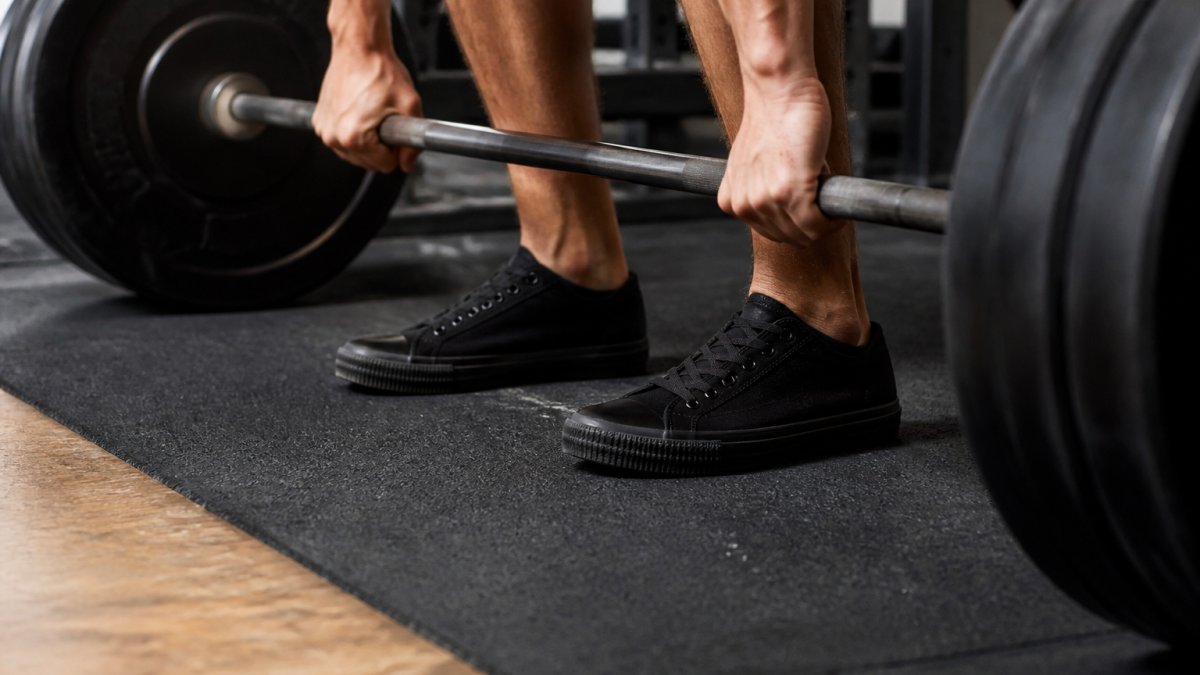
Stability depends on sole stiffness and structure, while grip is traction between shoe and floor.
| Component | What to Prioritize | Why It Matters |
|---|---|---|
| Sole stiffness | Rigid, minimal compression | Transmits force directly to platform |
| Grip pattern | Moderate, full-contact tread | Prevents sliding without catching seams |
| Heel lock | Snug counter, proper lacing | Prevents heel lift during drive |
| Arch support | Molded midsole with zero drop | Supports foot while maintaining stability |
| Traction surface | Flat rubber with shallow pattern | Adapts to textured or smooth platforms |
Deadlift Shoes with a Wide Toe Box: Fit for Different Foot Shapes
Not all feet are the same shape: a shoe that feels perfect for a narrow foot can feel cramped for a wide one. A cramped shoe limits your ability to spread your toes and create a stable base, when you pull heavy weight, your foot naturally spreads, and a cramped toe box fights this movement, forcing your arch to work harder and creating instability.
Most flat shoes designed for deadlifting have a roomier toe box than running shoes, but "roomy" is relative. Here's how to choose by foot shape and pulling style.
Measure before you buy
- Width: Use a Brannock device at a shoe store or trace your foot on paper and measure the widest point. Most people wear shoes one width too narrow. If you are between widths, size up in width, not length.
- Toe-box room: You want roughly a half-inch of space between your longest toe and the end of the shoe when standing. Your toes should splay without pressing the sides.
- Volume: High insteps need more volume over the top of the foot; low-volume feet may need a thinner sock or a lace lock to avoid heel slip.
Fit by shoe style
- Canvas high-tops and low-tops: Generally the most forgiving for wide feet. The fabric upper stretches slightly with break-in, and the toe box is usually roomier than purpose-built lifting shoes. The trade-off is less arch support and a softer heel counter.
- Wrestling shoes: Snug by design, with a narrow toe box and a thin, grippy sole. Good for narrow-footed pullers who want maximum ground feel, but often too tight for wide feet.
- Cross-trainers: Moderate width and volume, with more cushioning than a dedicated flat. Look for a "wide" width option if available; otherwise size up a half size and use a heel-lock lacing pattern.
- Deadlift slippers and minimal shoes: Very roomy and thin, but offer little structure. Best for experienced lifters who already have stable foot mechanics.
Conventional vs. sumo fit
Conventional pullers drive through the midfoot and heel, so heel lock and a secure midfoot matter most. Sumo pullers set up with the feet turned out and the knees pushed wide; they benefit from a wider toe box and a sole that does not catch when the foot rotates. If you pull sumo, prioritize a roomy forefoot and a smooth outsole over aggressive tread.
Sizing adjustments that work
- Half-size up if you are between sizes or plan to wear thicker socks.
- Heel-lock lacing (the top eyelets tied back through the loop) to prevent heel slip in a roomier shoe.
- Thin socks for a more precise fit in wrestling shoes or slippers.
Common Mistakes When Choosing Flat Shoes for Deadlifting
Most lifters make the same errors when selecting flat shoes deadlifting.
Mistake 1: Prioritizing aesthetics over function. A shoe that looks great might have a compressible sole or poor arch support.
Mistake 3: Buying based on brand name alone. Popular brands make good products, but popular doesn't always mean best-for-you.
Mistake 5: Confusing flat with unsupported. A flat sole doesn't mean no arch support.
Durability and Care: Making Your Lifting Shoes Last
The sole wears first: constant friction on the platform slowly breaks down the rubber.
The upper, fabric and stitching, lasts longer than the sole if you maintain it.
Wash your lifting shoes monthly. Use cool water and a soft brush.
You can find comprehensive guidance on washing performance apparel to maintain your gear properly.
When your shoes are done, you'll know: the sole won't grip, the upper has visible tears, and any cushioning is fully compressed. Replace them then, worn-out flat shoes for deadlifting compromise stability and increase injury risk.
The bottom line: Flat shoes for deadlifting are a fundamental tool, not a luxury.
At Mayhem Performance Apparel, we understand that serious training demands serious gear. The same discipline you bring to your lifting applies to every piece of equipment you use. Shop now →
Frequently Asked Questions
What makes flat shoes better for deadlifting than regular gym shoes?
Flat shoes provide direct contact with the lifting surface, eliminating the cushioning and heel elevation found in most running or cross-training shoes. This creates a stable, immobile base that improves force transfer from your feet through the bar. A firm sole prevents energy loss during the pull, and the zero-drop design keeps your foot flat on the ground, reducing ankle instability. Flat shoes for deadlifting also offer superior ground feel, which helps you maintain proper foot positioning throughout the lift.
Is it better to deadlift barefoot or in flat shoes?
Both work, but flat shoes offer practical advantages in most training environments. Barefoot deadlifting provides maximum ground feel and feedback, but many commercial gyms prohibit it for safety and hygiene reasons. Flat shoes deliver nearly identical stability and ground contact while meeting facility rules. For powerlifting competition, flat shoes are the standard choice. Beginners often benefit from flat shoes because they offer the ground feel advantage without the learning curve of barefoot lifting.
Should deadlift shoes have a wide toe box?
A wide toe box is valuable if you have a naturally wider foot or if you splay your toes during heavy pulls. Many lifters benefit from toe-box width because it reduces pressure on the medial foot and allows better foot stability. However, the priority is sole firmness and overall stability first, a tight, firm shoe outperforms a loose, soft shoe. If you have standard or narrow feet, a snug fit often provides better ground feel and control. Measure your foot width and test shoes before committing.
Can you deadlift effectively in Converse shoes or casual canvas shoes?
Yes. Converse and similar canvas shoes work because they have flat, firm soles and minimal cushioning. Many lifters use them successfully for deadlifting, squats, and bench press. The trade-off is durability, canvas wears faster under heavy, repeated training than specialized lifting shoes. Canvas shoes also offer less ankle support and may feel less stable on uneven or worn flooring. They're a budget-friendly option for testing flat-shoe deadlifting, but dedicated lifting shoes provide better longevity and performance under load.

0 comments