
Table of Contents
- Why Leggings Roll Down During Training
- Signs Your Leggings Are the Wrong Size
- How to Stop Leggings Rolling: Step-by-Step Fixes
- How to Wash Performance Leggings Without Killing Elasticity
- Why Do Gym Clothes Smell and How Fabric Affects Fit
- Matching Leggings to Your Body Shape and Activity
- Conclusion: Gear That Stays Put Under Load
- Frequently Asked Questions
Last Updated: September 12, 2026
Why Leggings Roll Down During Training
A waistband rolls down when the elastic cannot overcome the combined pull of movement, gravity, and a poor waist-to-hip match. The band creeps, folds, and settles below the hip bone, usually within the first few reps of a squat or burpee.
The fix starts with understanding what you are fighting. Here is the core problem: most leggings are designed for standing still, then sold for squatting.
The Physics of a Waistband That Won't Stay Put
Three forces act on your waistband at once. Downward drag from the fabric's weight and sweat load. Outward pressure from your hips and glutes as you move. And the elastic's own recovery force pushing back.
When the elastic's recovery force loses to the other two, the band slides. Elasticity in spandex and elastane degrades with heat, chlorine, and repeated stretching, so a pair that held firm in month one can fail by month six (PubMed).
Signs Your Leggings Are the Wrong Size
The clearest sign is a waistband that needs adjusting every few minutes, not every few sessions. If you tug your leggings up mid-set, the size is wrong, regardless of what the label says.
Watch for these signals:
- Waistband gaps at the back when you hinge forward
- Fabric pulls tight across the hips but sags at the waist
- You size down to stop rolling, then can't breathe in a deep squat
- Seams twist to the front during lunges
Sizing down is the most common mistake. A tighter band doesn't grip better; it just folds over itself faster.
The Waist-to-Hip Ratio Test
Measure your natural waist, the narrowest point above your navel. Measure your hips at the widest point. Divide waist by hip.
If your ratio sits below roughly 0.8, you likely need a high-waisted cut with a wider band. Above 0.85, a mid-rise with a contoured waistband follows your shape better. This number matters more than the size on the tag.
How to Stop Leggings Rolling: Step-by-Step Fixes
You can stop leggings rolling with three fixes, ranked from fastest to most permanent. Try them in order and stop when the band holds through a full session. The third fix is the one almost no guide covers, and it is the one that saves a good pair from the donation bin.
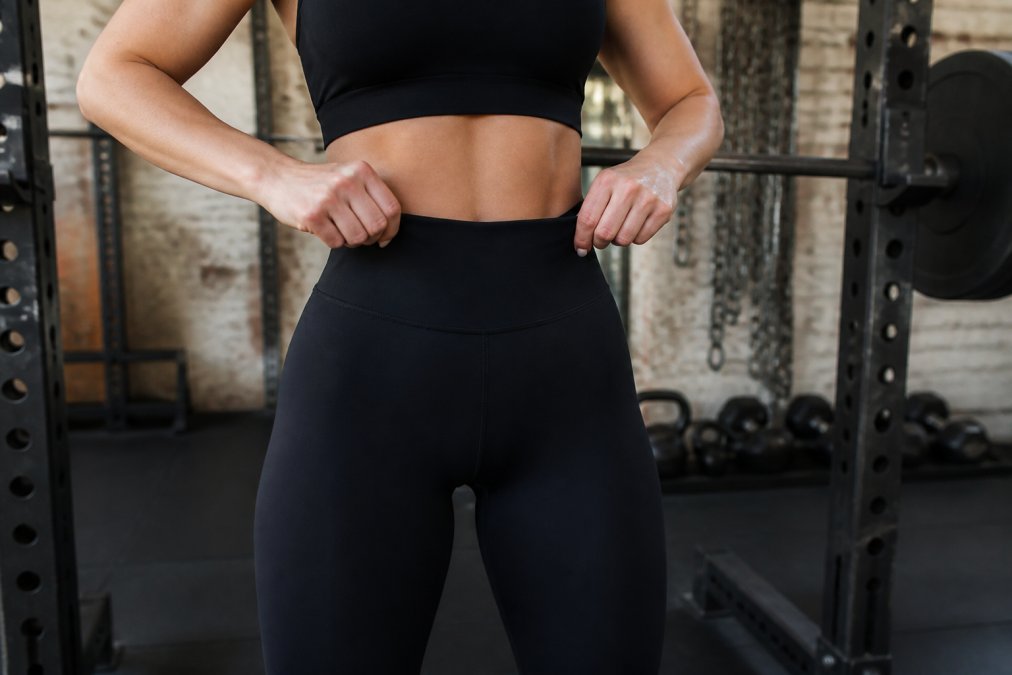
Fix 1: The Waistband Fold and Tuck
Fold the top inch of the waistband inward, against your skin. The doubled fabric adds friction and shortens the band's lever arm, so it resists rolling. This buys you a session, not a season. It works best on bands at least 1.5 inches wide; on a thin 1-inch band, the fold just creates a new roll point.
Fix 2: Silicone Grip and Drawstring Adjustments
Check whether your leggings have a silicone grip strip inside the band. If they do, wear them with the grip against bare skin, not over a base layer. Silicone needs direct contact to generate shear resistance; a cotton tee between the strip and your skin defeats it entirely.
If your leggings have an internal drawstring, cinch it snug, then tie it flat so it doesn't create a pressure point under a belt. A common mistake is tying the drawstring in a bow at the front, which adds bulk exactly where the band needs to sit flush.
Fix 3: Post-Purchase Modifications That Actually Work
This is the fix most people never consider, and it extends a good pair by years. Two modifications solve the vast majority of rolling problems on leggings that fit everywhere except the waist.
Add silicone grip strips. You can buy rolls of silicone elastic gripper tape (often sold as "waistband gripper" or "bra strap gripper" tape) at most fabric and craft stores. Cut a strip roughly 6 to 8 inches long, center it on the inside back of the waistband, and stitch it down with a zigzag stitch so the band can still stretch. Place it at the back, not the front, that is where the band lifts first when you hinge or squat. A tailor can do this for a small fee, usually under what a new pair costs.
Take in the back seam. If the waist gaps at the back but fits at the hips, a tailor can open the back waistband seam, remove a wedge of fabric (typically 1 to 2 inches total, split across two darts), and resew it. This is the correct fix for a waist-to-hip mismatch. It is not the same as sizing down, because the hips and legs keep their original fit.
Add an internal elastic band. For leggings with a wide, hollow waistband, a tailor can thread a 0.5-inch piece of knit elastic through the casing and anchor it at the side seams. This restores the recovery force the original elastic lost. Ask for knit elastic, not braided, knit stretches with the fabric and won't create a hard ridge.
| Fix | Effort | How Long It Lasts | Best For |
|---|---|---|---|
| Fold and tuck | Seconds | One session | Quick test before training |
| Silicone grip / drawstring | Minutes | Until fabric wears | Leggings with grip or drawstring |
| Add silicone strip | 15-30 min or a tailor visit | Life of garment | Bands that slip at the back |
| Take in back seam | Tailor visit | Life of garment | Waist-to-hip mismatch |
| Add internal elastic | Tailor visit | Life of garment | Stretched-out wide bands |
How to Wash Performance Leggings Without Killing Elasticity
Heat and harsh detergent destroy elastic faster than training does. That is not a slogan, it is the mechanism behind most "my leggings used to stay up" complaints. Understanding why elastane fails tells you exactly which care habits matter and which are just folklore.
Why Elastane Stops Recovering
Spandex (also called elastane or Lycra) is a segmented polyurethane. Its stretch comes from soft segments that uncoil under tension and hard segments that hold the fiber together. Two things break that system:
- Heat relaxes the hard segments and lets the soft segments take a permanent set. Once that happens, the fiber stretches but does not snap back. This is why a hot dryer is the single worst thing you can do to performance leggings.
- Chlorine and oxidizing detergents attack the polyurethane backbone directly. Pool water and bleach-based stain removers both accelerate this. Even repeated exposure to oxygen-based "color-safe" bleach can shorten fiber life.
A pair that held firm in month one can fail by month six because the elastic has taken a set, not because the leggings shrank or you gained weight. The fabric still fits; the recovery force is gone.
Care Rules That Actually Protect Elasticity
- Turn leggings inside out before washing. This puts the abrasive action against the inner surface, not the outer knit.
- Use cold water and a mild detergent. Skip fabric softener and skip chlorine bleach.
- Air dry flat, away from direct heat. Never put performance leggings in a dryer, even on low.
- Wash less often than you think. Spot-clean between sessions and air out after each wear.
- If you swim in them or they contact pool water, rinse immediately in cold fresh water.
Fabric softener coats synthetic fibers and blocks moisture-wicking, which is why gym wear feels clammy after a few washes. The FTC care label guidance on garment care is a useful reference for reading the symbols on your tag.
How to Tell If Elasticity Is Already Gone
The stretch test is simple. Hold a section of the waistband between both hands and pull it to roughly 1.5 times its resting length. Release. A healthy band snaps back to its original size within a second. A degraded band returns slowly, returns only partway, or stays slightly stretched. If it fails this test, no wash routine will bring it back, that pair is a candidate for the DIY fixes above or for replacement.
Why Do Gym Clothes Smell and How Fabric Affects Fit
Gym clothes smell because synthetic fibers trap bacteria and body oils that cotton releases more readily. Polyester and elastane blends hold odor until a proper wash breaks the biofilm down.
The fit connection matters too. Odor-causing bacteria thrive in damp fabric, and a waistband that traps sweat against your skin stays damp longer. Moisture-wicking fabric moves sweat away from the body, which keeps both the smell and the sliding in check.
Pilling is a related warning sign. Once synthetic fibers pill, the surface roughens, friction changes, and the band grips less predictably.
Matching Leggings to Your Body Shape and Activity
The right legging for a heavy squat session is not the right legging for a low-impact yoga class. Match the garment to the load.
For high-impact and heavy lifting, choose high-waisted styles with four-way stretch, a wide contoured waistband, and a drawstring. For low-impact work, a lighter compression rating with a standard elastic band is fine. Body shape drives the cut: pear shapes do better with a wider band that anchors above the hip, while straighter shapes often need a drawstring to lock the fit.
Compression ratings run light to firm. Firm compression holds the band in place under load but restricts movement if it's too tight. A fit test tells you more than the rating: squat, hinge, and jump in the fitting room or before you commit.
American Council on Exercise guide to workout apparel covers how activity type should shape what you wear.
Conclusion: Gear That Stays Put Under Load
Rolling waistbands are a fit, fabric, and care problem, not a personal failing. Fix the fit first, protect the elasticity second, and modify the garment third. Do those three things and most leggings will hold through a full session.
When a pair still won't stay put after all of that, the garment has reached the end of its useful life. Mayhem Performance Apparel builds gym clothing engineered to withstand relentless training, with durable gear that holds up under pressure and fabric designed for athletes who operate under load. If your current gear keeps failing you, it's time to replace it with apparel built to endure.
Shop now →
Frequently Asked Questions
What does it mean when your leggings keep rolling down?
A waistband that rolls down usually signals a fit or fabric problem. The most common causes are a waistband that is too narrow for your torso length, fabric that has lost its elasticity from repeated washing, or a size that does not match your waist-to-hip ratio. High-waisted styles with wide, reinforced waistbands and four-way stretch fabric resist rolling far better than low-rise or thin-banded options.
Are my leggings rolling down because they are too small?
Yes, sizing down is a frequent culprit. When leggings are too tight, the fabric stretches past its limit and the waistband curls inward instead of lying flat. Check for signs your leggings are the wrong size: deep crease lines at the waist, restricted movement during squats, or the band folding over within minutes of putting them on. If any of these sound familiar, try your true size before blaming the fabric.
Does fabric composition affect how leggings fit during exercise?
Fabric composition matters more than most people realize. Leggings with a high spandex or elastane content (20% or more) hold their shape through repeated stretching, while cotton-heavy blends lose elasticity and start sliding. Synthetic fibers like polyester and nylon paired with spandex give you the tensile strength and fabric recovery needed for high-impact training. Check the tag: if spandex is below 15%, expect more sliding over time.
How should high-waisted leggings fit to prevent rolling?
High-waisted leggings should sit at or just above your natural waist, not compress your ribs. The waistband should lie flat with no gaping or digging. Run a fit test: squat deeply, hinge forward, and jump. If the band stays put through all three, the fit is right. If it rolls, the waistband is either too narrow, too tight, or the fabric lacks enough four-way stretch to recover after movement.
0 comments