
Last Updated: October 30, 2026
Quick Summary
Choosing leggings for different body types starts with four measurements: waist, hip, inseam, and rise. Match rise to torso length, size to your hip when waist and hip land in different sizes, and pick a cut that follows your hip-to-waist ratio rather than a body-shape label.
- High-rise leggings suit longer torsos, while mid-rise works better for shorter torsos.
- Measure your waist at its narrowest point and your hip 7 to 9 inches below it.
- When waist and hip fall in different sizes, size to the hip and adjust the waistband.
- Petite frames do best with a cropped or 7/8 length and a higher rise.
- Buying a size down for more compression backfires by reducing opacity and range of motion.
Table of Contents
- Why Leggings Fit Differently on Different Bodies
- Types of Leggings and Their Fits
- Leggings Sizing and Fit Guide: Measure Before You Buy
- High-Waisted Leggings for Different Body Types
- Leggings for Curvy Body Types
- Leggings for Petite, Tall, and Straight Frames
- Fit Problems and How to Troubleshoot Them
- Build Your Training Rotation with Mayhem Performance Apparel
- Frequently Asked Questions
Why Leggings Fit Differently on Different Bodies
Leggings for different body types guide every purchase decision, and most fit problems start with a simple mismatch: the garment was cut for one set of proportions and worn by another.
Fit is not vanity; it is function. The Research Journal of Textile and Apparel study on young consumers' perceptions of leggings shows that wearers judge leggings largely on how they feel in motion, not on the label size.
Types of Leggings and Their Fits
Leggings fall into a small number of structural categories, and each one suits a different set of proportions. The main variables are rise, length, compression level, and seam construction. Get those four right and most fit issues disappear before you ever set foot in the gym.
- High-rise: sits at or above the navel, best for longer torsos and anyone who wants waistband security under a belt
- Mid-rise: sits below the navel, a good match for shorter torsos and athletes who dislike pressure across the stomach
- Full length: reaches the ankle, the default for cold gyms and barbell work
Rise, Length, and Compression at a Glance
| Style | Best For | Watch Out For |
|---|---|---|
| High-rise, full length | Longer torsos, heavy lifting | Can bunch on short torsos |
| Mid-rise, cropped | Shorter frames, warm gyms | Less waistband security |
| High compression | Squats, deadlifts, support | Can feel restrictive if oversized |
| Low compression | Recovery days, layering | More fabric shift under load |
If you are weighing whether a tighter knit is worth it, our breakdown of whether high compression gear is worth it for lifting covers the performance trade-offs. For a deeper dive into opaque, heavy-duty options, see our guide to heavy duty squat proof leggings.
Leggings Sizing and Fit Guide: Measure Before You Buy
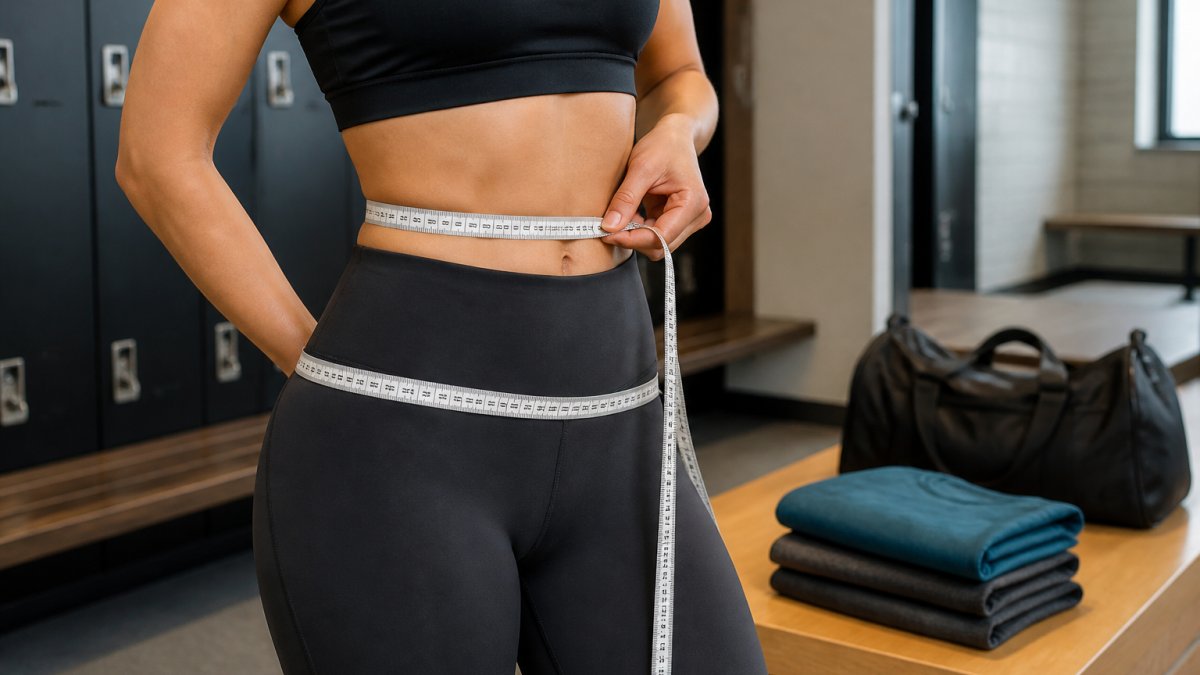
A leggings sizing and fit guide should start with four numbers: waist, hip, inseam, and rise. Most size charts only publish waist and hip, but rise is the measurement that decides whether a waistband sits on your ribs or rolls under your belt. Measure all four, write them down, and compare them against each brand's own chart, because grading varies between manufacturers even when the tag size is identical.
How to Take Each Measurement
Use a soft, non-stretch tape and keep it snug against the skin without compressing it. Wear the underwear you normally train in, and measure late in the day when your body is at its normal size rather than first thing in the morning.
- Waist: measure at the narrowest point of your torso, usually just above the navel. Keep the tape level all the way around; a tape that dips at the back will read low.
- Hip: measure at the fullest point of your seat, typically 7 to 9 inches below the waist. Stand with feet together so the tape captures the widest circumference.
- Inseam: stand against a wall without shoes and measure from the crotch seam down the inside of the leg to the ankle bone. If you already own a pair of leggings whose length you like, lay them flat and measure the inseam seam-to-seam instead; that number transfers more reliably than a body measurement.
Reading a Size Chart Without Guessing
Size charts are built from body measurements, not garment measurements, so match your numbers to the chart rather than to the size you wear in jeans.
When your waist and hip land in different sizes, size to the hip. A waistband can be adjusted with a drawcord, a contoured cut, or a higher rise; a tight hip cannot be fixed without returning the garment.
Why Body-Shape Labels Are Optional
Body-shape categories can be a useful shortcut, but they are not a rulebook. Two athletes with the same hip-to-waist ratio can need different rises because their torso lengths differ, and a label like "curvy" or "straight" does not tell a brand how long your inseam is.
A practical next step is to compare your numbers against the rise and length guidance in the sections below, then check the fabric notes before you buy.
High-Waisted Leggings for Different Body Types
High-waisted leggings for different body types work best when the rise matches your torso length. A high rise gives security and a clean line under a lifting belt, but on a short torso it can bunch at the ribs.
For athletes who squat and pull heavy, a wide, flat waistband with a firm knit holds position better than a narrow elastic band. If your waistband keeps sliding, our guide on how to stop leggings rolling walks through the fixes that actually hold.
Leggings for Curvy Body Types
Leggings for curvy body types should be chosen by hip-to-waist ratio, not by a size label. When the hip measurement is significantly larger than the waist, a straight-cut pattern pulls tight across the hip and gaps at the back waist.
Fabric matters here too. A knit with good recovery snaps back after stretching over the hip, while a looser cotton blend can bag out over a long session.
Shop Mayhem Performance Apparel →
Leggings for Petite, Tall, and Straight Frames
Petite frames do best with a shorter inseam and a higher rise relative to torso length. A full-length legging on a shorter frame often pools at the ankle or bunches behind the knee, which interferes with footwork.
Tall athletes face the opposite problem: standard lengths hit above the ankle and look short, and a low rise leaves a gap at the back. Our guide to the best inseam length for barbell training breaks down how to match length to your frame.
Straight or slim frames have the easiest time with standard cuts, but a straight leg can still gap at the waist if the hip is narrow. A drawcord or a contoured waistband solves it.
Fit Problems and How to Troubleshoot Them
Most leggings fit problems trace to one of five causes: wrong rise, wrong size, weak recovery fabric, a pattern cut for different proportions, or a seam placed where your body flexes. Diagnose the symptom before you buy again, because the same visible problem can come from different causes and the wrong fix wastes money.
A Symptom-to-Cause Checklist
Work through these in order. The first two checks, rise and size, resolve most issues without a return.
- Waistband rolls down: the rise is too low for your torso, or the band is too narrow to resist folding under a belt. Try a higher rise with a wider, flat band. If the band is wide but still rolls, the knit may be too stretchy for the load; a denser fabric with better recovery holds position better.
- Waistband digs or leaves marks: the waist is cut too straight for your hip-to-waist ratio, so the fabric has to compress to stay up. Look for a contoured waist that dips slightly at the front, or a curvier cut that takes in the waist without squeezing.
- Fabric goes sheer at depth: the knit is too thin or the size too small. Size up first, then choose a denser, higher-gauge fabric. Opacity is a function of fabric weight and stretch, not of color alone; a light color in a dense knit can be more opaque than a dark color in a thin one.
Test Before You Commit
A short try-on test catches most of these problems before a session does. Squat to depth, hinge forward, and check the waistband and the front rise in a mirror.
If you are deciding between compression levels, our breakdown of whether high compression gear is worth it for lifting covers the performance trade-offs, and our guide on how to stop leggings rolling walks through the fixes that actually hold.
Build Your Training Rotation with Mayhem Performance Apparel
Getting the fit right is the first step. Keeping gear that survives repeated sessions is the second, and that is where most leggings fail. Mayhem Performance Apparel is built for athletes who demand consistent discipline and gear that performs under repeated stress. Mayhem Performance Apparel is engineered to withstand relentless training and heavy-duty use.
You can browse the Mayhem Performance Apparel range to find the fit that suits your frame.
Frequently Asked Questions
Can all body types wear leggings?
Yes. There are no rules about which leggings a body type can wear; fit advice is a guideline, not a gatekeeper. What changes between bodies is the combination of rise, inseam, and compression that keeps a pair in place. Measure your waist, hip, and inseam, then match those numbers to a size chart rather than guessing from a model photo. The right pair is the one that stays put through your training, whatever shape you train in.
Is it better to size up or down for leggings?
Size to your largest measurement, usually the hip, and check the size chart's stretch allowance. Sizing down to chase compression is the most common mistake: the waistband digs in, seams pull, and the fabric thins over the seat under load. Sizing up too far leaves extra fabric that bunches in a squat. If you fall between sizes, go up and rely on a drawcord or higher rise for hold. Leggings sizing and fit guide charts exist for this reason, so use them.
How can you tell if leggings fit properly?
Run three checks before you train in them. First, squat and lunge in front of a mirror: the waistband should stay at your waist without rolling and the fabric should not go see-through at the seat. Second, check the crotch and inner thigh for pulling or a drop crotch. Third, confirm the inseam hits where you want it, full length at the ankle or cropped below the calf. Any pair that fails the squat test will fail under a loaded bar.
What leggings are best for a curvy body?
Look for a high-waisted cut with a wide, flat waistband, four-way stretch, and a gusseted crotch. Curvy body types often need more room through the hip and thigh with a waistband that does not gap at the back, so a contoured or seamed waistband helps. Check opacity by stretching the fabric over your hand in daylight. Leggings for curvy body types should hold shape through repeated wear, so prioritize dense knit fabrics over thin cotton blends.
How many types of leggings are there?
Most training leggings fall into a few practical categories: high-waisted compression, mid-rise everyday, seamless knit, cotton blend, and performance fabric built for sweat. Each differs in rise, inseam, and how much support it gives. For lifting, a high-waisted performance pair with four-way stretch covers most needs. For recovery days, a softer cotton blend works. Knowing the types of leggings and their fits makes it easier to pick the right one for the session.
Will high-waisted leggings stay up during heavy squats?
They can, if the waistband is wide, flat, and made of dense fabric rather than a thin elastic band. Waistbands roll down when the band is too narrow for the load or the size is too small. Check that the rise sits at or above your natural waist and that the fabric has enough compression to hold without digging in. Test with bodyweight squats before adding weight, then progress to a loaded session.
Fit is personal, and the right pair should disappear under the bar rather than demand your attention mid-set. Mayhem Performance Apparel makes durable, performance-first bottoms built for athletes who train regardless of circumstance, with fabric and construction designed to endure rigorous conditions. Get started with Mayhem Performance Apparel and build a rotation that holds up as long as you do.

0 comments