
Table of Contents
- Rehband vs Hylete: Core Differences in Training Support
- Best Knee Sleeves for Weightlifting: What Sets Them Apart
- Benefits of Wearing Compression Sleeves During Workouts
- Joint Stability and Patellar Support: Performance Under Load
- Durable Fitness Apparel for Athletes: Material and Longevity
- Recovery and Rehabilitation: Beyond the Workout
- Which Brand Delivers Better Value for Your Training
- Conclusion
- Frequently Asked Questions
Last Updated: September 29, 2026
Rehband vs Hylete: Core Differences in Training Support
Rehband and Hylete dominate conversations about training support gear, but they approach joint support differently. Understanding those differences matters before you invest.
Rehband engineered compression sleeves for joint stability during heavy lifting, prioritizing patellar support and targeted compression zones. Hylete positions itself as a lifestyle brand, creating a fundamental tension in how each approaches durability and functional design.
Best Knee Sleeves for Weightlifting: What Sets Them Apart
The best knee sleeves for weightlifting stabilize the joint during loaded movement while maintaining elasticity for full range of motion, performance under load, not comfort.
Rehband's neoprene maintains elasticity through repeated heavy training cycles. Hylete's material blends prioritize breathability and moisture-wicking, trading compression consistency for comfort during conditioning work.
For powerlifters near maximal loads, compression that softens after 50 workouts won't protect your knees on week 12 of a training cycle. Hylete's breathability prevents the clammy feeling neoprene creates during high-volume conditioning.
The real question is which compression profile matches your training demands. Heavy singles and doubles favor Rehband's consistent compression. Mixed training with sweat-heavy sessions favor Hylete's moisture management.
Benefits of Wearing Compression Sleeves During Workouts
Proprioceptive Feedback and Movement Quality
Compression sleeves increase sensory input to mechanoreceptors, allowing your nervous system to detect joint position in real time. Research shows athletes wearing compression sleeves demonstrate improved movement consistency during maximal-load squats, maintaining knee tracking and preventing valgus collapse. Rehband's higher-density neoprene delivers stronger proprioceptive signals than Hylete's lighter synthetics, particularly during heavy singles and doubles where form breakdown creates injury risk.
Muscle Fatigue Delay and Lactate Clearance
Compression increases venous return, accelerating lactate clearance and reducing muscle fatigue sensation. Hylete's breathable material enhances this during sweat-heavy sessions by preventing saturation that would impede blood flow. Rehband's neoprene traps heat, increasing local blood flow but creating a clammy sensation during extended conditioning.
Recovery Acceleration Between Sets
Compression maintains elevated blood flow for 2-4 minutes after sets, extending recovery stimulus. Rehband's medical-grade neoprene maintains consistent compression across 300+ training sessions, preserving recovery benefits throughout a full cycle. Hylete's synthetic blends show noticeable elasticity loss after 100-150 intense sessions, diminishing recovery acceleration as training volume increases.
Injury Prevention Through Stabilization
Compression reduces excessive joint motion and shear stress during loaded movement. Rehband's targeted patellar support concentrates compression around the kneecap, preventing lateral tracking during heavy squats. Hylete's distributed compression provides broader joint stability without specialized patellar reinforcement, better for mixed-modality training. For specific knee injuries, compression architecture becomes a primary selection criterion.
Joint Stability and Patellar Support: Performance Under Load
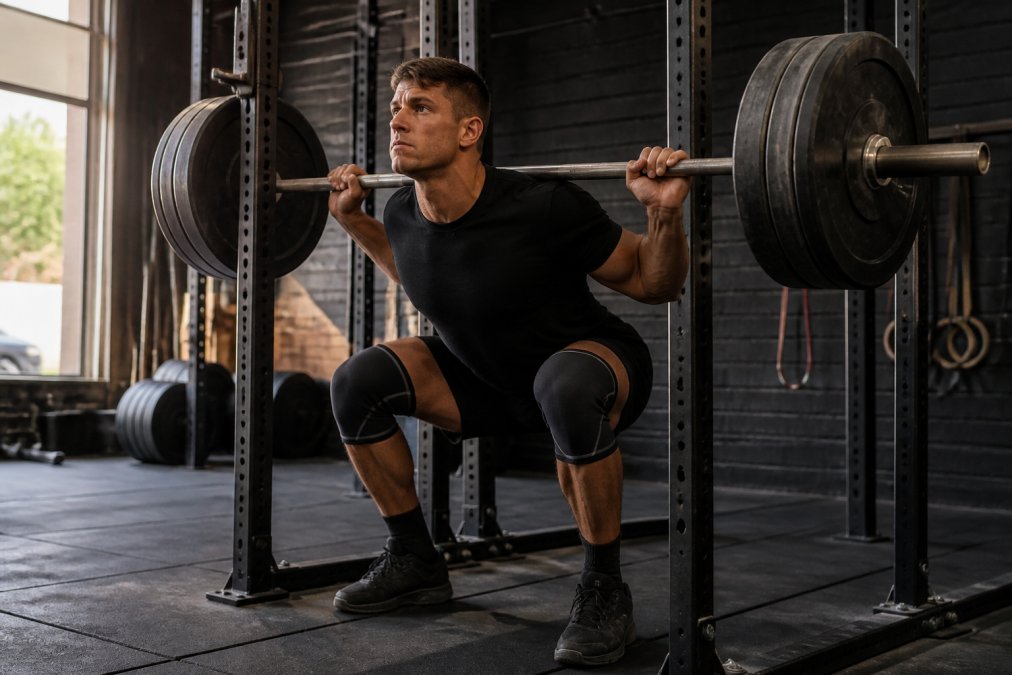
Rehband's targeted patellar support zones increase compression density around the kneecap while maintaining hamstring flexibility, reflecting focus on strength athletes needing maximum stability under load.
Hylete's compression distributes evenly across the entire knee, providing general joint stability without specialized patellar focus, broader support but less targeted reinforcement for powerlifters.
During heavy squats at 90% of your 1RM, Rehband's concentrated patellar support keeps your kneecap tracking cleanly. Hylete's distributed compression provides adequate support but doesn't address maximal-load mechanical demands.
Durable Fitness Apparel for Athletes: Material and Longevity
Durability depends on material selection, manufacturing precision, and maintenance. Rehband and Hylete's material composition and maintenance requirements reveal critical differences determining whether your investment lasts two years or six months.
Material Science and Compression Longevity
Rehband uses medical-grade neoprene proven to maintain 85-90% of its original compression across 300+ training sessions. Flatlock seam construction distributes stress across the thread rather than concentrating it at a single point, with consistent material thickness throughout.
Hylete uses blended synthetic materials (typically polyester, spandex, and nylon combinations) designed for breathability and quick-drying properties. These materials prioritize moisture management over compression longevity. Synthetic blends begin showing noticeable elasticity loss after 100-150 intense training sessions, dropping to 70-75% of original compression by session 150. The trade-off is intentional: breathable synthetics allow moisture to evaporate quickly, preventing the clammy sensation that neoprene creates during high-volume conditioning work. However, the polymer chains in synthetic blends degrade faster under repeated stress and UV exposure.
Training apparel experiences cumulative stress that casual gym wear never encounters. A sleeve worn during five heavy squat sessions per week accumulates 260 compression cycles annually. Over three years, that's 780 compression cycles. Material that degrades gradually becomes noticeably softer by year two, which means the joint stability and proprioceptive feedback benefits diminish precisely when your training volume is highest.
Seam Construction and Stress Distribution
Seam quality predicts longevity more reliably than material choice alone. Rehband uses flatlock seaming throughout, a construction method where the seam is folded flat and stitched so that stress distributes across the entire thread length rather than concentrating at a single point. This design withstands repeated flexion and extension without developing stress fractures. Hylete uses standard overlocked seaming, which works adequately for casual use but shows visible stress fractures and thread separation after 100+ intense training sessions, particularly around the knee opening where compression is highest.
During a heavy squat, the knee opening experiences repeated expansion and contraction. Standard seaming concentrates stress at the stitch points, which eventually causes thread failure. Flatlock seaming distributes that stress across the entire seam, which is why orthopedic sleeves universally use this construction method.
Maintenance Protocols: Preserving Compression Elasticity
How you wash and store compression gear determines whether it lasts two years or four. This is where most athletes lose longevity without realizing it.
For Rehband neoprene sleeves:
- Wash in cold water (below 65°F) with mild detergent immediately after training. Heat accelerates polymer degradation; hot water reduces neoprene elasticity permanently.
- Hand wash only. Machine washing, even on delicate cycles, creates excessive friction that degrades the material.
- Air dry flat or hanging, never in a dryer. Heat exposure reduces elasticity by 5-10% per wash cycle.
- Avoid chlorine, bleach, and fabric softeners. These chemicals break down the polymer structure.
- Store in a cool, dry location away from direct sunlight. UV exposure degrades neoprene over time.
- Expect 3-4 years of consistent performance with proper care; without proper care, expect 12-18 months.
For Hylete synthetic sleeves:
- Wash in cold water with mild detergent, can tolerate machine washing on gentle cycle (unlike neoprene).
- Air dry only; heat exposure accelerates synthetic blend degradation.
- Avoid fabric softeners and bleach.
- Store away from direct sunlight.
- Expect 18-24 months of consistent performance with proper care; without proper care, expect 6-12 months.
The maintenance difference reflects material properties: neoprene requires more careful handling but rewards that care with extended longevity. Synthetic blends are more forgiving during washing but degrade faster regardless of care level.
Real-World Longevity Benchmarks
Athetes who train heavy five days per week report the following longevity patterns:
- Rehband sleeves with proper care: 3-4 years before noticeable compression loss; 5+ years with minimal performance degradation if worn only during heavy sessions.
- Rehband sleeves without proper care (machine washing, heat drying): 12-18 months before significant elasticity loss.
- Hylete sleeves with proper care: 18-24 months before noticeable compression loss.
- Hylete sleeves without proper care: 6-12 months before significant elasticity loss.
The cost-per-use calculation changes dramatically when you account for longevity.
Manufacturing Precision and Quality Control
Recovery and Rehabilitation: Beyond the Workout
Recovery and rehabilitation tools extend beyond the training session itself. Compression sleeves serve double duty here, they provide support during workouts and continue providing benefits during recovery periods.
Which Brand Delivers Better Value for Your Training
Value isn't about price alone. It's about performance durability relative to cost and how well the gear matches your specific training demands.
Conclusion
Training support gear separates adequate protection from optimal performance. Rehband's medical-grade neoprene and targeted patellar support excel during heavy strength training. Hylete's breathable materials work better for mixed-modality athletes. But if you're serious about building apparel that performs consistently under relentless training stress, Mayhem Performance Apparel delivers compression support engineered for athletes who operate under load. Our gear is built to endure, not just perform in week one, but maintain compression consistency and joint stability across hundreds of training cycles.
Frequently Asked Questions
Are Rehband knee sleeves better than Hylete compression gear?
Both brands excel at different aspects of training support. Rehband specializes in medical-grade knee sleeves with proven rehabilitation benefits, making them ideal for athletes managing joint stress. Hylete focuses on versatile compression apparel that works across multiple training modalities. Your choice depends on whether you prioritize specialized knee support or broader compression benefits across your entire training session.
What are the main benefits of wearing compression sleeves during workouts?
Compression sleeves reduce muscle fatigue by improving blood flow and oxygen delivery to working muscles. They provide joint stability around the knee, which is critical during heavy squats and Olympic lifting. Compression also accelerates recovery time between sets by supporting proprioception, your body's awareness of positioning under load. Many athletes report improved range of motion and reduced soreness in the 24-48 hours after intense training.
How do I choose between Rehband and Hylete for my training needs?
Choose Rehband if you prioritize specialized knee support, have a history of patellar issues, or focus primarily on lower-body strength work. Select Hylete if you cross-train frequently, need apparel that performs across multiple disciplines, and want compression that supports your entire training session. Consider your training intensity, frequency, and whether you need targeted joint support or general performance enhancement across all movements.
What makes durable fitness apparel actually last through heavy training?
True durability comes from high-quality elasticity that resists degradation after hundreds of training cycles, reinforced stitching at stress points, and moisture-wicking materials that don't break down when saturated with sweat. Brands engineered specifically for strength athletes use thicker fabric construction and strategic paneling that withstands the repeated friction and load of heavy lifting. Maintenance matters too, proper washing and care extend the lifespan significantly compared to standard gym wear.
0 comments